At a glance
AKHQ and Offset Explorer are scored here on the same five criteria, 50 points in all: AKHQ 37 out of 50, Offset Explorer 26 out of 50. AKHQ takes its best score on Cost as teams grow (10 out of 10) and its lowest on Support and maintenance (5 out of 10). Cost a year, modelled: $0 licence plus about $8,640 operator time (6 hours a month at $120). Offset Explorer takes its best score on Deployment footprint (7 out of 10) and its lowest on Access control and audit (1 out of 10). Cost a year, modelled: $1,390 in licences for 10 users plus about $11,520 operator time (8 hours a month at $120).
AKHQ vs Offset Explorer, compared
Kpow meets 6 of 7 requirements on this page. One row is not a yes or no question.
Key takeaway
AKHQ is free under Apache 2.0 with no paid tier, and Offset Explorer is licensed per named user at 139 US dollars each for the first ten. AKHQ is one container a platform team deploys once, reaching one cluster or many, configured in YAML under Helm. Offset Explorer installs on each engineer’s own machine, and its documented authentication is client to broker only, so nothing authenticates a person and there is no identity for an audit trail to key on. Kpow by Factor House is licensed per cluster at a published price.
Kpow live demo
Test the trade-offs in a live Kafka UI
You have compared AKHQ vs Offset Explorer. Open a live Kpow environment to test the everyday workflows a shared Kafka platform needs.
Built for platform and data teams managing shared Kafka clusters.
Try the Kpow demoWhat is AKHQ?
AKHQ is an open-source Kafka management UI under Apache 2.0, formerly KafkaHQ, self-hosted and built on Micronaut. One deployment reaches one cluster or many, covering topic browsing, live tailing, producing, consumer groups, Schema Registry, Kafka Connect, ACL management and role-based access with LDAP and OIDC. There is no commercial edition, no hosted service and no paid support tier, and no feature is held back from the open release.
 Rank 1
 AKHQ
akhq.io
37 out of 50 Total
- Cost a year, modelled
- $0 licence plus about $8,640 operator time (6 hours a month at $120)
- Where it runs
- One JVM container, deployed by Helm
- Who it authenticates
- People: LDAP, OIDC, HTTP basic
- Cost as teams grow
- 10 out of 10
- Deployment footprint
- 8 out of 10
- Support and maintenance
- 5 out of 10
- Access control and audit
- 5 out of 10
- Multi-cluster reach
- 9 out of 10
Why these scores for AKHQ
- Cost as teams grow 10 out of 10
- This page’s table gives the pricing unit as “Free, Apache 2.0, with no paid tier and no commercial support”, and free use as “All use, with no licence to buy”. This page’s estimate of the annual total: $0 licence plus about $8,640 of operator time, at 6 engineer-hours a month at $120 an hour. The 10 scores the slope, not the level: the bill does not move when the team grows.
- Deployment footprint 8 out of 10
- This page’s table gives where it runs as “One JVM container reaching one cluster or many, deployed by Helm”, with no external database, docked for the memory reports open since July 2022 and May 2025.
- Support and maintenance 5 out of 10
- This page has “There is no SLA, because there is nobody to escalate to”, against 0.28.0 in August 2026 after 0.27.1 in May and 0.27.0 in March.
- Access control and audit 5 out of 10
- This page’s table gives who it authenticates as “People, with LDAP, OIDC and HTTP basic, plus external role and claim mapping”, but masking and audit are “configured globally rather than per role”.
- Multi-cluster reach 9 out of 10
- This page’s table gives where it runs as one container reaching “one cluster or many”, with the cluster list in YAML under Helm.
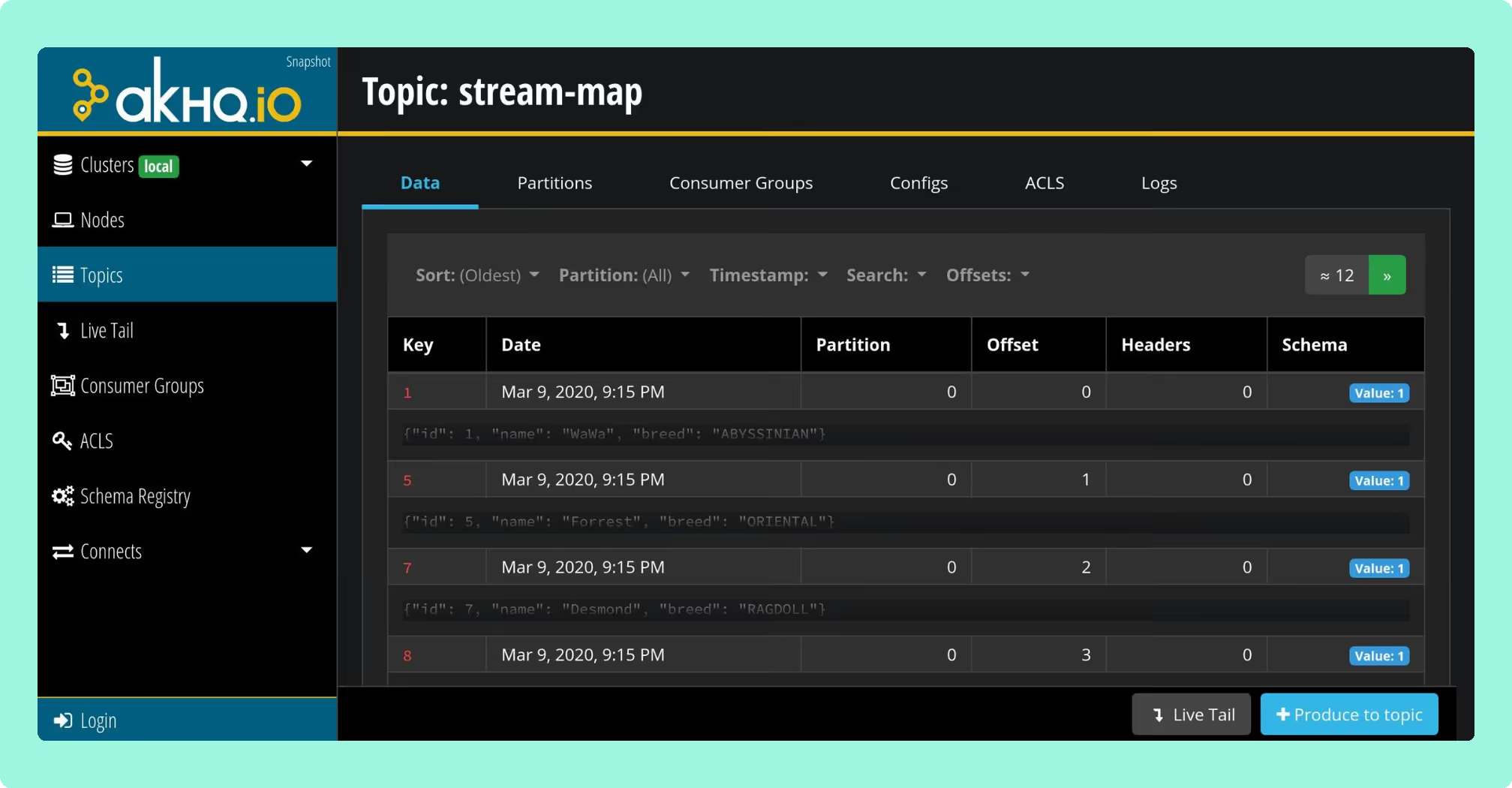
Releases: 0.28.0 in August 2026, after 0.27.1 in May and 0.27.0 in March.
Maintainership: 441 commits from the lead maintainer, 82 from the next human contributor.
Configuration: YAML deployed by Helm, so the cluster list and access model sit in source control.
Deployment: one container, no external database.
Audit: opt-in, written to a Kafka topic the operator nominates, with no audit view inside the product.
Metrics: port 28081 carries Prometheus metrics, a health endpoint and log level control, all describing AKHQ itself. No JMX visualisation and no alerting.
Memory: a constant-increase report open since July 2022, and a second from May 2025.
OIDC: the most active failure surface in the tracker, with new reports arriving in August 2026.
Staying patched: release 0.28.0, cut on 6 August 2026, bundles 270 libraries and 18 of them carry a high or critical advisory. Sixteen of the eighteen were already public, with fixed versions already on Maven Central, on the day it shipped, and five of those are netty CVEs Kpow had already remediated in release 96.2 three weeks earlier: CVE-2026-44249, CVE-2026-45416, CVE-2026-45674, CVE-2026-47691 and CVE-2026-50010. The oldest has been open 108 days. Every jar AKHQ ships resolves to a coordinate, so this is a complete count rather than a floor, and each identifier can be checked at nvd.nist.gov. A shipped vulnerable library is exposure and remediation latency, not a working attack.
Compare Kpow vs AKHQAKHQ vs Kafbat UIAKHQ vs KafdropAKHQ review
What is Offset Explorer?
Offset Explorer is a GUI application for managing and using Apache Kafka clusters, installed on an engineer’s own machine rather than deployed as a service. It runs on Windows, macOS and Linux, with a bundled JRE on the first two and Java 21 or later required on Linux. It was renamed from Kafka Tool and the vendor’s domain is still kafkatool.com, so the two names refer to one product. It is built by DB Solo, LLC, licensed per named user, and supports Apache Kafka 0.11 and above.
It is not a thin viewer, and the licence buys a vendor with support and maintenance attached to it.
 Rank 2
 Offset Explorer
kafkatool.com
26 out of 50 Total
- Cost a year, modelled
- $1,390 in licences for 10 users plus about $11,520 operator time (8 hours a month at $120)
- Where it runs
- A desktop install on each machine
- Who it authenticates
- The connection only, never a person
- Cost as teams grow
- 5 out of 10
- Deployment footprint
- 7 out of 10
- Support and maintenance
- 6 out of 10
- Access control and audit
- 1 out of 10
- Multi-cluster reach
- 7 out of 10
Why these scores for Offset Explorer
- Cost as teams grow 5 out of 10
- This page’s table gives “139 US dollars each at 1 to 10 users, 128 at 11 to 20, 119 at 21 to 50, and no published price above that”, and free use is “Personal use only”. This page’s estimate of the annual total for ten engineers: about $12,910, the $1,390 of named-user licences plus 8 engineer-hours a month at $120 an hour, with $460 a year after the first to stay current.
- Deployment footprint 7 out of 10
- This page’s table gives where it runs as “An installed desktop application on each engineer’s machine”, so nothing runs server-side, but configuration is per workstation and travels as exported files.
- Support and maintenance 6 out of 10
- This page’s table gives Staying current as “365 days of support and maintenance are included, then 46 US dollars per licence a year”, and the page records that the vendor publishes a change history with no date against any version.
- Access control and audit 1 out of 10
- This page’s table gives the governance surface as “No RBAC, no audit logging and no data masking on the feature list”, and the documented authentication is client to broker, so there is no user identity for an audit trail to key on.
- Multi-cluster reach 7 out of 10
- This page gives Apache Kafka 0.11 and above with Compare Clusters as a first-class documented feature, but each workstation holds its own cluster list rather than a shared one.
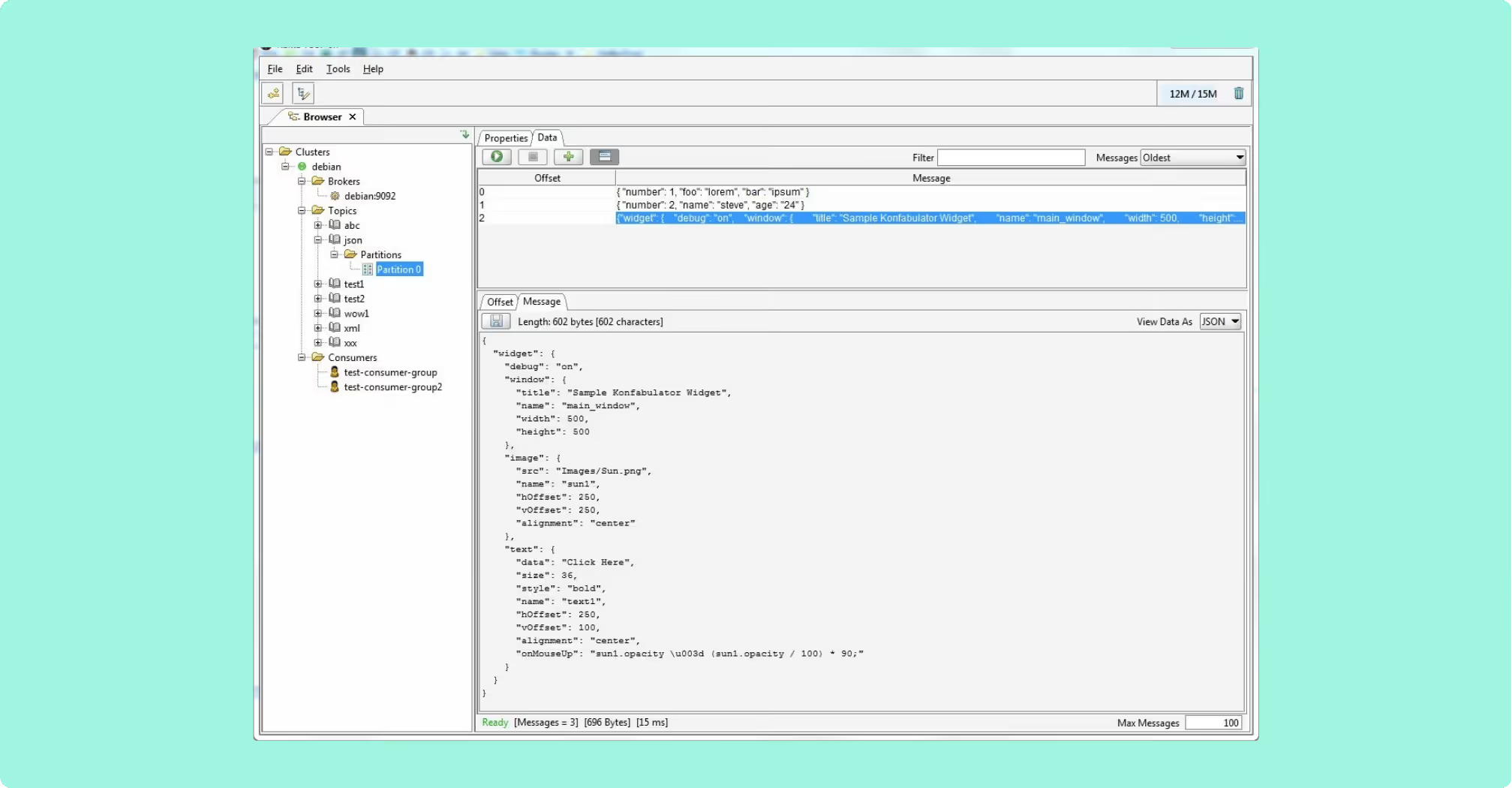
Message search: string, binary, Avro, Protobuf, JSON Schema, regular expressions and JsonPath.
Compare Clusters: a first-class documented feature rather than a plugin.
Command line tool: replays a project file saved from the GUI, with text, JSON, XML or CSV output and a nonzero exit on failure.
Recent versions: 4.0.4 added the Cluster Compare tool, and 4.0.3 added KRaft quorum support, broker quotas and OAuth token testing.
Governance: no role-based access control, no audit logging and no data masking on the feature list.
ACLs: managed from the command line tool rather than the interface.
Configuration: per workstation, travelling between engineers as exported files rather than from a shared store.
Release history: the vendor publishes a change history with no date against any version on it.
Compare Kpow vs Offset ExplorerConduktor vs Offset ExplorerCMAK vs Offset ExplorerKafka Tool download
What is the official 2026 pricing of AKHQ and Offset Explorer?
AKHQ costs nothing to license, and its whole cost is operator time. Somebody sizes the JVM, reads the issue tracker before an upgrade, and answers for it when it stops. There is no SLA, because there is nobody to escalate to.
Offset Explorer publishes a per-user ladder. One to ten users is 139 US dollars each, so five engineers is 695 US dollars. Eleven to twenty is 128 each, so twenty engineers is 2,560 US dollars. Twenty-one to fifty is 119 each, and above fifty there is no published price. Every purchase includes 365 days of support and maintenance, after which staying current is 46 US dollars per licence a year. The unit is the named user, so the bill tracks headcount and not cluster count, and a machine several people share needs a licence for each person on it. Personal use is free with no time limit; commercial, educational and non-profit use all require a purchased licence after a 30-day evaluation.
Where does each one run out?
The scoring is the same on both sides: five criteria, 10 points each, 50 in all, with every criterion counting once. Nothing sits behind a multiplier, so a total is the sum of its five marks and a reader can recompute it. The five are cost as teams grow, deployment footprint, support and maintenance, access control and audit, and multi-cluster reach, because those are the questions a Kafka interface is actually measured against after the first month: a second cluster, an access review with a date on it, an upgrade nobody owns, and a bill that moves when the team does. The widest gap between the two marks is on cost as teams grow, where AKHQ marks 10 and Offset Explorer marks 5. The marks come from the same matrix used on every comparison on this site, so a tool scores the same here as it does anywhere else, and the reason behind each mark is in the card below, under Why these scores.
The dependency figures in the cards below were read on 24 September 2026 from each project’s published release artefact and matched against the NVD and GitHub advisory databases, so they move whenever a release or an advisory lands. Kpow is self-hosted as well. What a licence buys here is not a different deployment model, it is a company under contract to ship the patched build.
AKHQ’s governance is present but shallow. Masking takes four modes, configured globally in application YAML and keyed on topic and field path, so what is hidden does not vary by who is looking, and only one filter per topic is supported.
Offset Explorer’s limits follow from being a desktop application. The documented authentication is client to broker only: plaintext, SASL, SSL with a truststore and OAUTHBEARER all authenticate the connection, and nothing authenticates a person to the application, which leaves no user identity for a role model or an audit trail to key on.
Which should you pick?
AKHQ is the pick where a platform team deploys once for everybody, because Offset Explorer installs on each engineer’s own machine and authenticates nothing about the person, so there is no identity for an audit trail to key on. Offset Explorer suits an individual engineer at 139 US dollars. For a shared, governed surface with an audit view, shortlist Kpow by Factor House at a published per-cluster price.
Pick AKHQ if:
- more than a handful of people need the view
- the people who need it should not all hold broker credentials
- there is more than one cluster to look at
- the cluster list and access model belong in source control
Pick Offset Explorer if:
- the work is one engineer’s and stays that way
- the payload formats are awkward and the search has to cover Protobuf and JsonPath
- diffing two clusters before a cutover is routine
- the team is under about ten engineers who all hold cluster access anyway
The line between them is not which interface is better. It is whether the thing the team needs is a service or an application. A personal tool becomes team infrastructure the day somebody who does not hold cluster credentials needs to look at a topic, and neither answers that day well: one has no user to attach a permission to, and the other names the user and still hides the payload by a global rule that is the same whoever is looking. Once that day arrives, Kafka RBAC tools covers the products that do attach a permission to a person, and the best Kafka management tools sets both of these against the wider field.
Kpow: the bill tracks clusters, not people
Neither of these prices the cluster. Offset Explorer bills per named user, so the number grows every time somebody new needs a topic browser, and AKHQ bills nothing on paper but takes the same growth out of operator time instead: somebody still sizes the JVM and reads the tracker before every upgrade. Kpow by Factor House is licensed per cluster at a published price, so the number doesn’t move when a team of five becomes a team of fifty: one stateless container, no external database, and up to 12 clusters from a single instance.
That’s the number worth watching as headcount changes. Run it against yours to see what stays fixed.
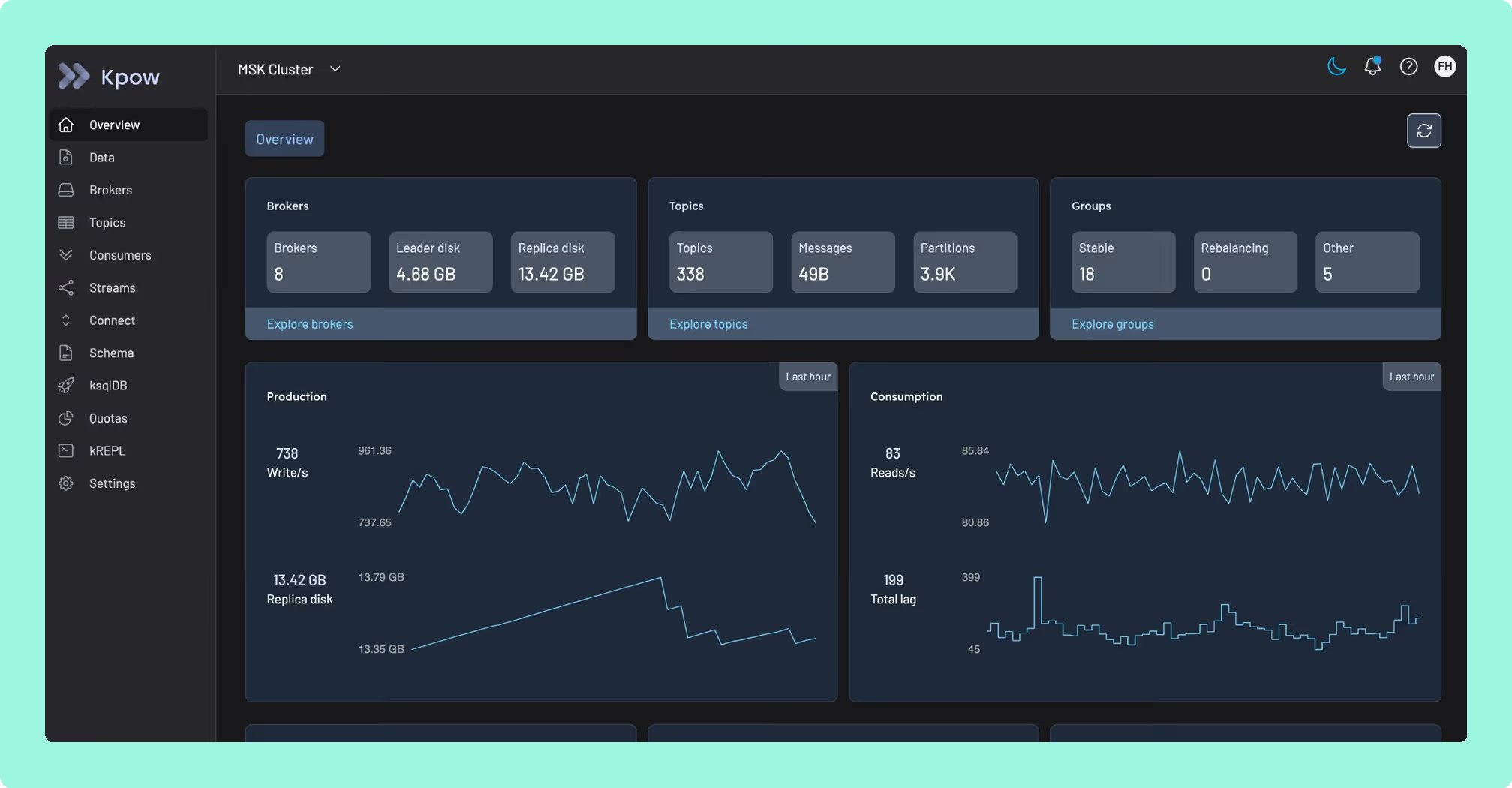
How these tools were scored
Every option is scored from 0 to 10 on each criterion, from the evidence and sources this page cites, and the reason for each score is on its card. Each criterion counts once, for a total out of 50. The options are listed by total.
Sources
- Apache Kafka documentation on authorization
- Apache Kafka documentation on consumer groups
- Apache Kafka documentation on KRaft