At a glance
Confluent Control Center and Conduktor are scored here on the same five criteria, 50 points in all: Confluent Control Center 20 out of 50, Conduktor 36 out of 50. Confluent Control Center takes its best score on Access control and audit (7 out of 10) and its lowest on Cost as teams grow (2 out of 10). Cost a year, modelled: $22,080 in a migration year, plus an unpublished licence. Conduktor takes its best score on Access control and audit (10 out of 10) and its lowest on Deployment footprint (3 out of 10). Cost a year, 50 seats: $60,000 on Team Edition, plus about $2,880 operator time. Conduktor holds the highest total on this page at 36 out of 50.
Conduktor vs Confluent Control Center, compared
Kpow meets 5 of 6 requirements on this page. 2 rows are not a yes or no question.
Key takeaway
Control Center requires the proprietary Confluent Metrics Reporter in the broker classpath, so it cannot monitor Amazon MSK, Redpanda or Aiven, and it has no price of its own: it ships bundled with a Confluent Platform enterprise licence. Conduktor runs against any distribution, and Team Edition is 1,200 US dollars per seat per year, but Console requires PostgreSQL 13 or later, and Gateway sits in the data path. Kpow by Factor House is licensed per cluster at a published price.
Kpow live demo
Test the trade-offs in a live Kafka UI
You have compared Conduktor vs Confluent Control Center. Open a live Kpow environment to test the everyday workflows a shared Kafka platform needs.
Built for platform and data teams managing shared Kafka clusters.
Try the Kpow demoWhat is Conduktor?
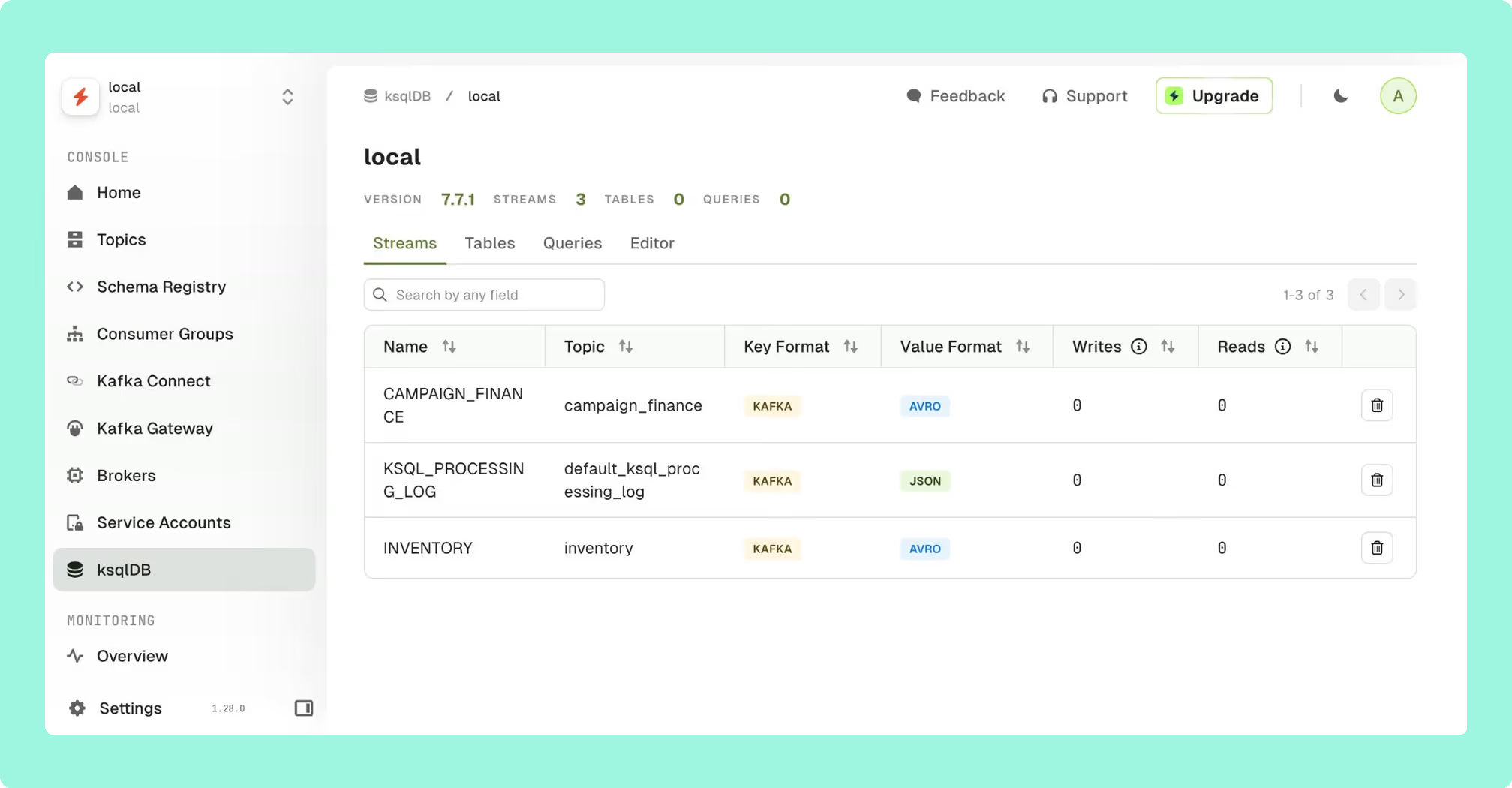
Conduktor is a commercial Kafka management and governance platform sold as three separately licensed products. Console is a web interface over topics, schemas, connectors, consumer groups and access control across clusters. Gateway is a proxy between clients and brokers that enforces encryption, data masking, quota policy and multi-tenancy at the wire level, so producers and consumers need no change to their code. A Schema Registry Proxy is sold on its own tier again.
- Field-level encryption: applied without touching a client.
- Virtual topics: server-side filtering with no stream processor behind it and no duplicate physical topic.
- Failover: a backend cluster swap that applications never have to be reconfigured for.
- Reach: self-managed Kafka, Amazon MSK with IAM, Redpanda, Aiven, Strimzi, Confluent Platform and Confluent Cloud.
The company was SOC2 Type II certified in 2023. One piece of history matters before an evaluation starts: Conduktor began as a JavaFX desktop application, and that product was retired at the end of 2025.
What is Confluent Control Center?
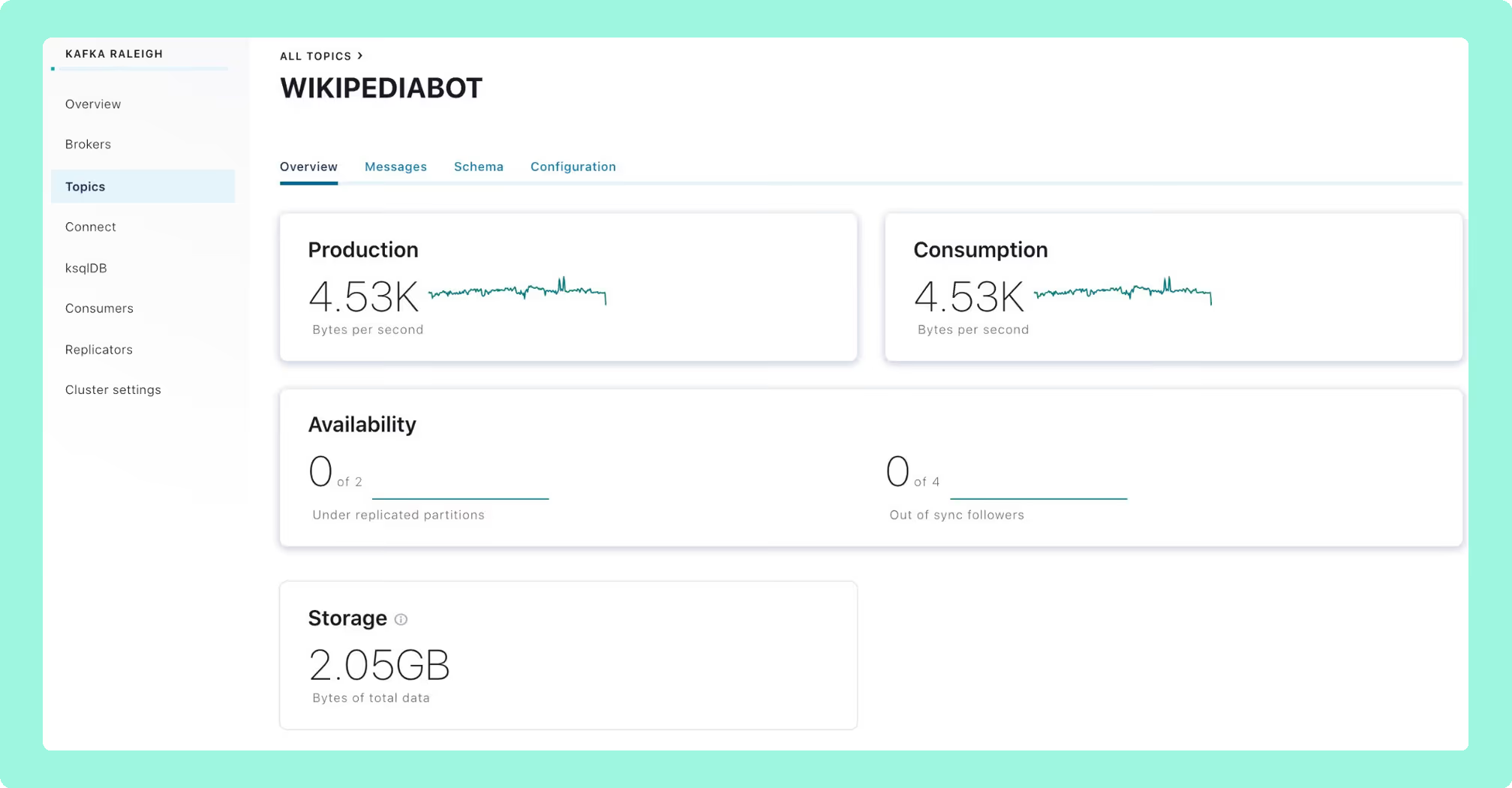
Control Center is a web management and monitoring interface bundled with Confluent Platform, Confluent’s commercial Kafka distribution. It is closed source, it ships under an enterprise licence, and it is not sold on its own. One dashboard covers brokers, topics, consumer groups, Kafka Connect workers, Schema Registry, ksqlDB and Kafka Streams topologies. Two of those are the reason to buy it: Kafka Streams topology visualisation and native ksqlDB development exist in no open-source Kafka UI.
- Legacy architecture: shipped with Confluent Platform 7.x and earlier, running metrics through a Kafka Streams pipeline.
- Next generation: Prometheus-based, arriving with Control Center 2.0.0 in May 2025 and Confluent Platform 8.0 support a month later.
- What changed: startup fell from 15 to 50 minutes to about one, and supported partition scale rose from 120,000 to 400,000.
- Current line: Control Center 2.6.x, requiring Java 17.
Control Center requires the proprietary Confluent Metrics Reporter JAR in the broker classpath, and that JAR cannot be installed on Amazon MSK, Redpanda or Aiven. For a reader on a managed service, the comparison ends there.
What is the official 2026 pricing of Conduktor and Confluent Control Center?
Conduktor’s unit is the seat. Console Community is free for up to 50 users and 3 clusters. Console Team Edition is 1,200 US dollars per seat per year, or 125 US dollars per seat per month billed monthly. Gateway is licensed separately, per cluster, with a three-cluster minimum, and three of the five purchasable tiers carry no published price. Five engineers on Team Edition is 6,000 US dollars a year, fifty is 60,000, and a hundred lists at 120,000 before Gateway is licensed at all. What is unusual is where the governance sits: group-level RBAC, topic policies, unlimited audit logs and data masking are all Team Edition rather than Enterprise.
Control Center has no price of its own, because it is not sold on its own. It is bundled with a Confluent Platform enterprise licence and cannot be bought for a cluster somebody else runs. Control Center, multi-tenancy support and encryption each carry cost above the base licence. The enterprise licence covers quarterly patch updates for the current version only, and the Platinum support tier is not available for this product.
Where does each one run out?
Both tools are marked out of 10 on the same five criteria, for a total out of 50, and every criterion counts once. Nothing sits behind a multiplier, so a total is the sum of its five marks and a reader can recompute it. The five are cost as teams grow, deployment footprint, support and maintenance, access control and audit, and multi-cluster reach, because those are the questions a Kafka interface is actually measured against after the first month: a second cluster, an access review with a date on it, an upgrade nobody owns, and a bill that moves when the team does. The widest gap between the two marks is on multi-cluster reach, where Conduktor marks 9 and Confluent Control Center marks 3. The marks come from the same matrix used on every comparison on this site, so a tool scores the same here as it does anywhere else, and the reason behind each mark is in the card below, under Why these scores.
Confluent Control Center
confluent.io
20 out of 50 Total
- Cost a year, modelled
- $22,080 in a migration year, plus an unpublished licence
- Free tier
- None, beyond a time-limited evaluation
- Reaches
- Confluent Platform only
- Cost as teams grow
- 2 out of 10
- Deployment footprint
- 2 out of 10
- Support and maintenance
- 6 out of 10
- Access control and audit
- 7 out of 10
- Multi-cluster reach
- 3 out of 10
Why these scores for Confluent Control Center
- Cost as teams grow 2 out of 10
- This page’s table gives it no price of its own, bundled into an unpublished Confluent Platform enterprise licence, with Control Center, multi-tenancy and encryption each costing more; this page’s estimate of the work around it is $22,080 in a migration year, against $18,000 for Kpow Enterprise on four clusters.
- Deployment footprint 2 out of 10
- On this page, it needs the proprietary Confluent Metrics Reporter JAR in the broker classpath, and it must not share a node with Confluent Platform because the packages cause class-loading conflicts.
- Support and maintenance 6 out of 10
- This page gives quarterly patch updates for the current version only, no Platinum support tier for this product, and legacy to next generation as a full migration with 7 to 15 days running in parallel.
- Access control and audit 7 out of 10
- This page gives RBAC with audit logging, but single sign-on is OIDC only on self-managed deployments, so a SAML-only identity provider has no supported path, and no masking is described.
- Multi-cluster reach 3 out of 10
- This page’s table gives Confluent Platform only, because the Metrics Reporter JAR cannot be installed on Amazon MSK, Redpanda or Aiven.
Cost a year, modelled: Control Center has no price of its own, because it is bundled into a Confluent Platform enterprise licence that is not published, and Control Center, multi-tenancy and encryption each carry cost above it. What can be priced is the work around it, and this page’s estimate is $22,080 in a migration year: two engineer-hours a month at $120 an engineer hour on its dedicated node, which is $2,880, plus the legacy to next-generation migration the documentation puts at 7 to 15 days running both in parallel, which at two engineers for ten days is $19,200 once. Those hours are this page’s estimate, and they sit on top of a licence nobody publishes. Kpow Enterprise is $4,500 per cluster a year for up to 100 users, so the same four clusters are $18,000.
Control Center’s first limit is the Metrics Reporter, from the operator’s side: MSK, Redpanda and Aiven cannot be monitored at all, and MSK’s native IAM authentication is not supported either. The second is deployment. It must not sit on the same node as Confluent Platform, because Confluent packages on that host cause class-loading conflicts.
Single sign-on: OIDC only on self-managed deployments, so a SAML-only identity provider has no supported path.
Legacy interceptors: roughly 50 internal topics added to broker metadata, and at high consumer group counts that is where it falls over.
Startup: Kafka Streams can enter a rebalancing loop and leave the interface on a loading spinner for 20 to 30 minutes.
GitOps: UI-driven changes apply directly to cluster state rather than through a Git-managed manifest.
Moving from legacy to the next generation is a full migration rather than an upgrade: historical metrics do not carry over, and the documented advice is 7 to 15 days running both in parallel.
Compare Kpow vs Confluent Control CenterAKHQ vs Confluent Control CenterConfluent Control Center review
 Rank 2
 Conduktor
conduktor.io
36 out of 50 Total
- Cost a year, 50 seats
- $60,000 on Team Edition, plus about $2,880 operator time
- Free tier
- Community: 50 users, 3 clusters
- Runs on
- PostgreSQL 13+, plus Gateway proxy
- Cost as teams grow
- 5 out of 10
- Deployment footprint
- 3 out of 10
- Support and maintenance
- 9 out of 10
- Access control and audit
- 10 out of 10
- Multi-cluster reach
- 9 out of 10
Why these scores for Conduktor
- Cost as teams grow 5 out of 10
- On this page, Console Team Edition is $1,200 per seat per year, so fifty engineers is $60,000 a year and a hundred lists at $120,000 before Gateway is licensed at all, plus this page’s estimate of $2,880 to run it, at 2 engineer-hours a month at $120 an engineer hour; Kpow Enterprise is $18,000 for four clusters.
- Deployment footprint 3 out of 10
- On this page, PostgreSQL 13 or later is not optional, the minimum is 2 CPU and 3 GB for Console plus 2 CPU and 4 GB for Gateway, and Gateway sits inline in the data path.
- Support and maintenance 9 out of 10
- This page has it SOC2 Type II certified in 2023, sold and supported under contract on every paid tier.
- Access control and audit 10 out of 10
- On this page, group-level RBAC, topic policies, unlimited audit logs and data masking are all in Team Edition, and encryption and masking are enforced at the wire without touching a client.
- Multi-cluster reach 9 out of 10
- This page’s table gives any distribution, including self-managed Kafka, Amazon MSK, Redpanda, Aiven, Confluent Platform and Confluent Cloud.
Cost a year: Console Team Edition is $1,200 per seat per year, the vendor’s own published price, so fifty engineers is $60,000 a year before Gateway, which is licensed separately per cluster with a three-cluster minimum and no published price. This page’s estimate rather than a vendor price for running it, 2 engineer-hours a month at $120 an engineer hour, adds $2,880, so about $62,880. Kpow Enterprise is $4,500 per cluster a year for up to 100 users, so the same four clusters are $18,000, and that number does not move when the fifty-first engineer needs a login.
Conduktor Console requires PostgreSQL 13 or later, and it is not optional, so a management tool acquires a database with its own backups and upgrade path. Minimum resources are 2 CPU and 3 GB of RAM for Console, plus 2 CPU and 4 GB for Gateway.
Latency: Gateway is a proxy in the data path, and a proxy adds a network hop that can slightly increase end-to-end latency.
Availability: Gateway is a single point of failure needing its own plan, and disaster recovery is priced above Gateway Enterprise.
Index: Console falls back to querying the cluster directly when its internal index is stale, which shows as slow page loads.
Azure: Event Hubs is reachable over Kafka protocol compatibility, but Azure’s native Schema Registry is not integrated.
Compare Conduktor vs KadeckConduktor vs LensesConduktor review
Which should you pick?
Conduktor scores 36 against Control Center’s 20 and is the pick for any estate that is not entirely Confluent Platform, because Control Center needs Confluent’s proprietary reporter on every broker. Conduktor bills 1,200 US dollars per seat a year, needs PostgreSQL, and its Gateway sits in the data path. For governance out of the data path, priced per cluster, shortlist Kpow by Factor House.
Pick Control Center if:
- the cluster is Confluent Platform and will stay that way
- Kafka Streams topology work is the actual job
- ksqlDB development is part of the daily work
Pick Conduktor if:
- more than one distribution is in play now, or will be inside the licence term
- encryption or masking has to be enforced below the application
- virtual topics or wire-level quota policy are requirements
- topic creation is being handed to product teams inside policy guardrails
Running both is the normal third answer. Conduktor’s Console and Gateway both work against Confluent Platform and Confluent Cloud, and Conduktor positions that combination as complementary. In practice it is two products, two bills, a PostgreSQL instance, a proxy in the data path, and a platform licence underneath all of it. Where more than one distribution is already in play, Kafka multi-cluster tools compares what each option can reach, and the best Kafka monitoring tools covers the metrics half of the job.
Kpow: priced by the cluster, reaching any of them
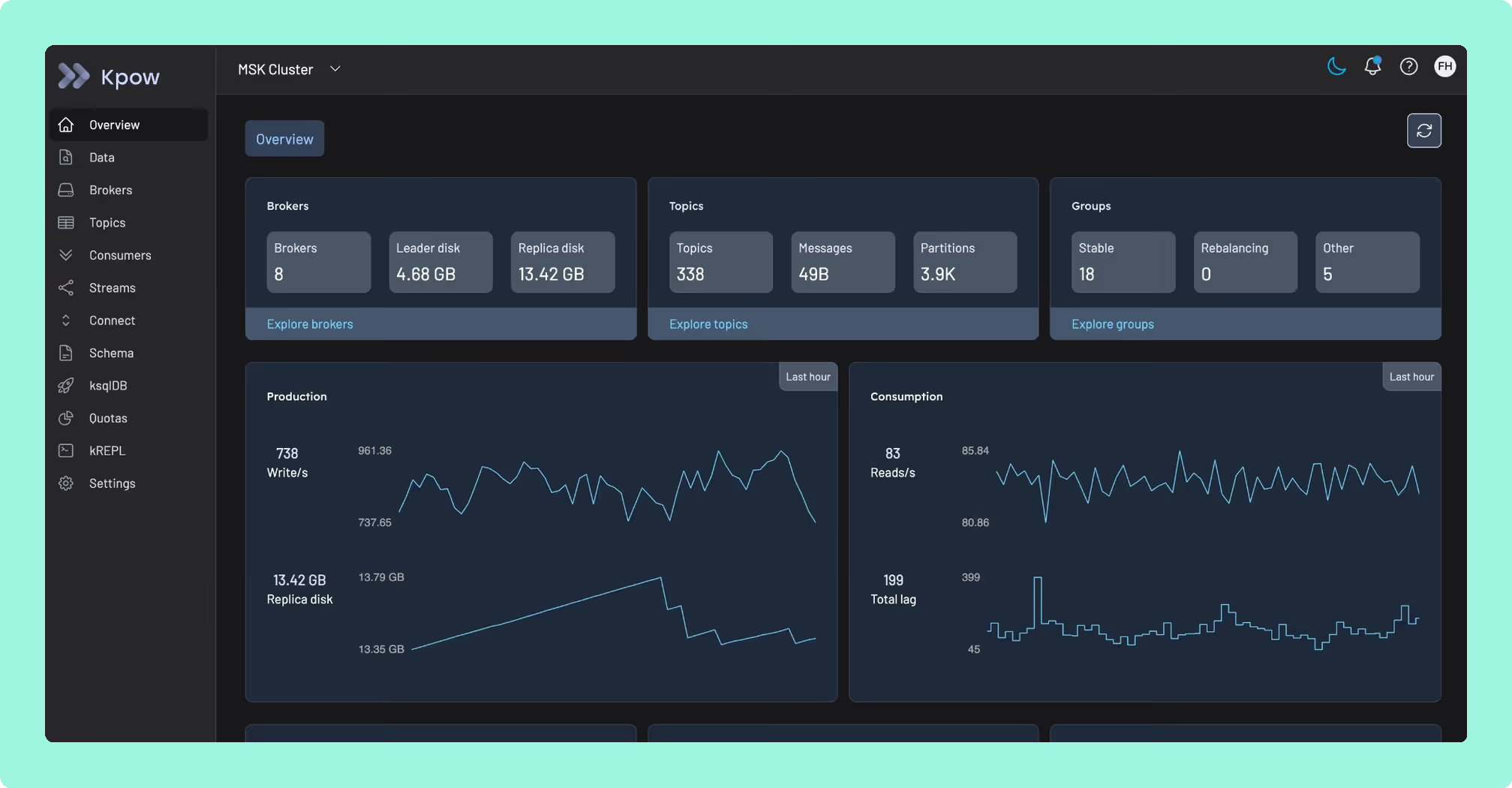
Neither of these prices what a platform team is actually running. Conduktor bills per seat, and Team Edition is 1,200 US dollars a year per person, so the number moves with headcount and Gateway is licensed again on top, sitting inline in the data path. Control Center has no price of its own at all: it ships bundled inside a Confluent Platform enterprise licence, and it cannot monitor Amazon MSK, Redpanda or Aiven because it requires the proprietary Metrics Reporter JAR in the broker classpath. Kpow by Factor House sits beside the cluster rather than in the data path, so it is not a proxy and enforces nothing on the wire. It is licensed per cluster at a published price, so headcount never moves the bill, in one stateless JVM container with no external database, reaching up to 12 clusters.
A price attached to the cluster is a price you can actually plan around. Kpow’s product page has the number, and it doesn’t change with the seat count or the distribution underneath.
How these tools were scored
Every option is scored from 0 to 10 on each criterion, from the evidence and sources this page cites, and the reason for each score is on its card. Each criterion counts once, for a total out of 50. The options are listed by total. Conduktor is listed last whatever its total; on its total of 36 it would place first.