At a glance
Kafdrop and Confluent Control Center are scored here on the same five criteria, 50 points in all: Kafdrop 23 out of 50, Confluent Control Center 20 out of 50. Kafdrop takes its best score on Cost as teams grow (10 out of 10) and its lowest on Access control and audit (0 out of 10). Cost a year (modelled): $0 licence, plus $11,520 in ops and access-control time. Confluent Control Center takes its best score on Access control and audit (7 out of 10) and its lowest on Cost as teams grow (2 out of 10). Cost a year (modelled): Licence not published, plus $2,880 in ops time.
Confluent Control Center vs Kafdrop, compared
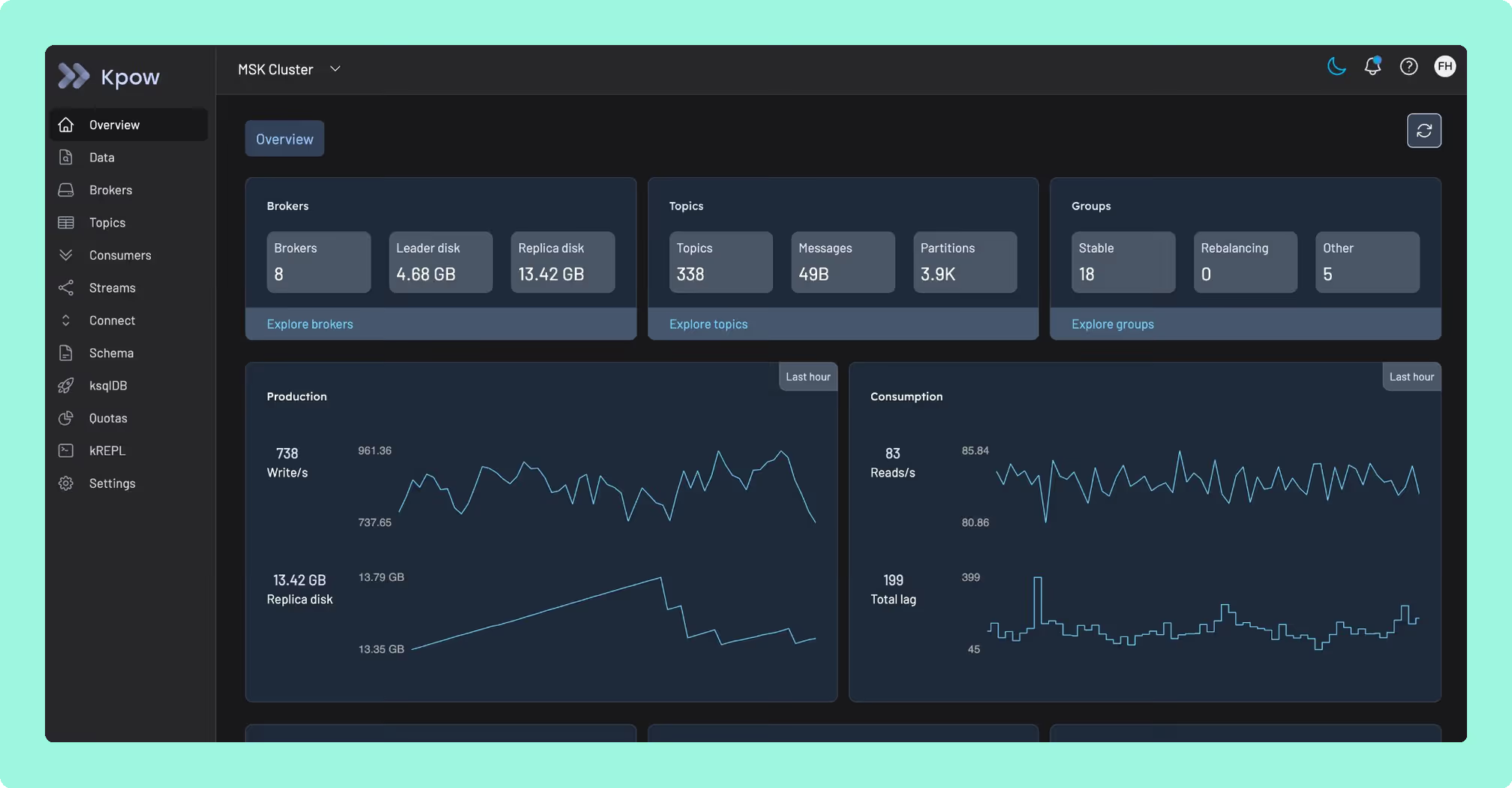
Kpow meets 7 of 8 requirements on this page.
Key takeaway
Control Center needs Confluent’s own reporter configured on every broker, so it does not reach Amazon MSK, Redpanda or Aiven, and it carries no published price of its own. Kafdrop connects to any Kafka from 0.11.0 and is free under Apache 2.0, but it has no authentication, no RBAC and no SSO, and its README documents an NGINX basic-auth workaround instead, and its newest tagged release is still 4.2.0, from July 2025. Kpow by Factor House is licensed per cluster at a published price.
Kpow live demo
Test the trade-offs in a live Kafka UI
You have compared Confluent Control Center vs Kafdrop. Open a live Kpow environment to test the everyday workflows a shared Kafka platform needs.
Built for platform and data teams managing shared Kafka clusters.
Try the Kpow demoWhat is Confluent Control Center?
Control Center is a web management and monitoring interface bundled with Confluent Platform, Confluent’s commercial Kafka distribution. It is closed-source and licensed as part of that platform. One dashboard covers brokers, topics, consumer groups, Kafka Connect workers, Schema Registry, ksqlDB and Kafka Streams topologies.
Control Center 2.0.0 and later takes its system health metrics through Confluent’s proprietary Telemetry Reporter, configured on every Kafka broker and KRaft controller, and the older Confluent Metrics Reporter serves Control Center (Legacy) only. Either way the reporter is broker-side, so standing Control Center up is a change to the brokers rather than to the tool, and that change cannot be made on Amazon MSK, Redpanda or Aiven.
Confluent Control Center
confluent.io
20 out of 50 Total
- Cost a year (modelled)
- Licence not published, plus $2,880 in ops time
- Needs on the broker
- Telemetry Reporter on every broker and controller
- Dedicated nodes
- 4 cores, 8 GB, 200 GB to 100,000 replicas
- Cost as teams grow
- 2 out of 10
- Deployment footprint
- 2 out of 10
- Support and maintenance
- 6 out of 10
- Access control and audit
- 7 out of 10
- Multi-cluster reach
- 3 out of 10
Why these scores for Confluent Control Center
- Cost as teams grow 2 out of 10
- This page has it bundled with Confluent Platform under an enterprise licence, with no published price and nothing to buy on its own, and Control Center, multi-tenancy support and encryption each carry additional cost. Cost of ownership modelled at $2,880 a year in ops time on top of an unpublished platform licence (this page’s estimate, 2 engineer-hours a month at $120 an hour).
- Deployment footprint 2 out of 10
- This page gives dedicated nodes, never the same node as Confluent Platform, at 4 cores, 8 GB and 200 GB of storage up to 100,000 replicas and 8 cores with 16 GB above that, plus Confluent’s own reporter on every broker and KRaft controller.
- Support and maintenance 6 out of 10
- This page gives a vendor under an enterprise licence, with quarterly patch updates for the current version only, no public issue tracker, and the Platinum support tier not available for this product.
- Access control and audit 7 out of 10
- This page gives RBAC with audit logging for authentication and authorisation events, OIDC only on self-managed, and a limit of 10,000 rules per cluster.
- Multi-cluster reach 3 out of 10
- This page gives Confluent Platform, with Confluent’s own reporter configured on every broker, which rules out Amazon MSK, Redpanda and Aiven.
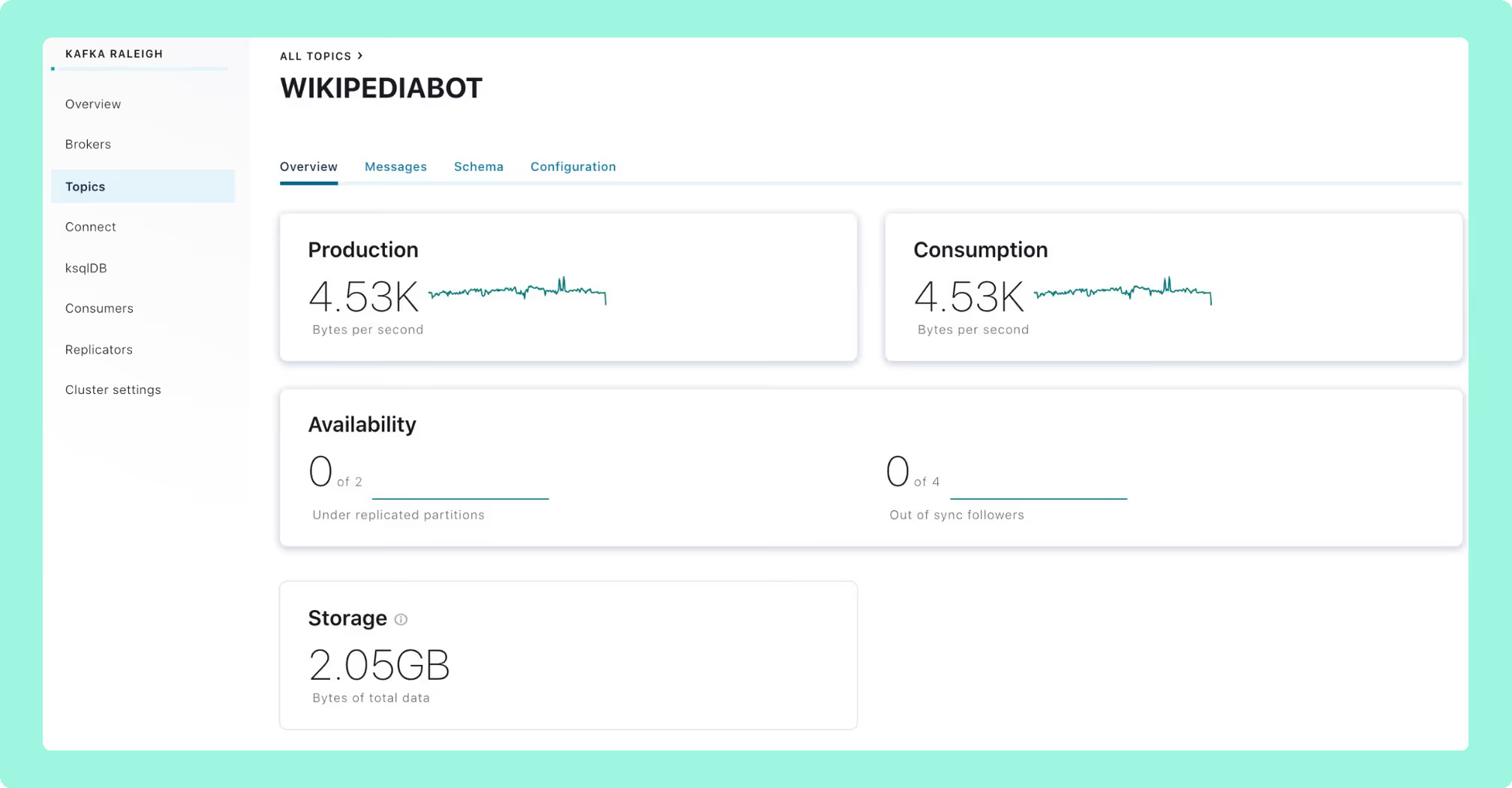
Architectures: a legacy Kafka Streams metrics pipeline on 7.x and earlier, and a Prometheus-based next generation from Confluent Platform 8.0 in May 2025.
Current line: 2.6.x, with 2.6.0 released on 14 July 2026, and Java 17 as a minimum.
Placement: it must not sit on the same node as Confluent Platform, because Confluent packages on the host cause class-loading conflicts.
RBAC: all or nothing. Metrics-only is not a configuration, and the scale limit is 10,000 rules per cluster.
Reduced infrastructure mode: keeps the management services and supplies no metrics, no monitoring data and no alerts.
Consumer lag: not tracked for consumers that call assign() rather than subscribe(), and Metrics API values do not update during a rebalance.
Kubernetes: Horizontal Pod Autoscaling is not supported for its pods, and UI changes apply straight to cluster state rather than through a Git-managed manifest.
Cost of ownership (modelled): Confluent does not publish a price for Control Center, so there is no licence line to quote. What can be counted is the running cost: a dedicated node to size and patch, a reporter to keep on every broker, and a legacy to next generation migration run in parallel for 7 to 15 days. At 2 engineer-hours a month at $120 an hour that is $2,880 a year before the platform licence itself, against a published Kpow licence of $4,500 per cluster a year for up to 100 users.
Compare Kpow vs Confluent Control CenterAKHQ vs Confluent Control CenterConfluent Control Center review
What is Kafdrop?
Kafdrop is an open-source Kafka web UI built on Spring Boot, licensed Apache 2.0, hosted at obsidiandynamics/kafdrop and maintained by the Obsidian Dynamics team. It runs as a stateless Java process against the standard broker protocols with no separate datastore. Requirements are Java 17 or newer and Kafka 0.11.0 or newer, or Azure Event Hubs, and the UI serves on port 9000. A ZooKeeper connection has not been required since 3.10.0.
- view brokers, and browse topics and partition state
- inspect messages in JSON, plain text, Avro and Protobuf
- view consumer groups with combined and per-partition lag
- create topics, and view ACLs
Kafdrop
github.com/obsidiandynamics/kafdrop
23 out of 50 Total
- Cost a year (modelled)
- $0 licence, plus $11,520 in ops and access-control time
- Newest release
- 4.2.0, 31 July 2025
- Access control
- None. An NGINX basic-auth workaround in the README
- Cost as teams grow
- 10 out of 10
- Deployment footprint
- 10 out of 10
- Support and maintenance
- 2 out of 10
- Access control and audit
- 0 out of 10
- Multi-cluster reach
- 1 out of 10
Why these scores for Kafdrop
- Cost as teams grow 10 out of 10
- This page has it free under Apache 2.0 in one tier, with no commercial edition and no supported tier, so the whole cost is operator time. Cost of ownership modelled at $11,520 a year (this page’s estimate, 8 engineer-hours a month at $120 an hour, covering both running it and fronting it with authentication) on a $0 licence.
- Deployment footprint 10 out of 10
- This page gives one stateless Java process, with no database and no sidecar, running on a small heap.
- Support and maintenance 2 out of 10
- This page has the newest tagged release still at 4.2.0 from 31 July 2025, a public tracker carrying 46 open issues with nobody under contract, and three KRaft failure reports closed as not planned, the last in April 2025.
- Access control and audit 0 out of 10
- This page gives no authentication, no RBAC and no SSO, an NGINX basic-auth workaround documented in the README instead, and write operations exposed with the read-only pull request open since 30 November 2020.
- Multi-cluster reach 1 out of 10
- This page gives no multi-cluster management. It reaches any Kafka from 0.11.0 speaking the admin API, plus Azure Event Hubs, one cluster at a time.
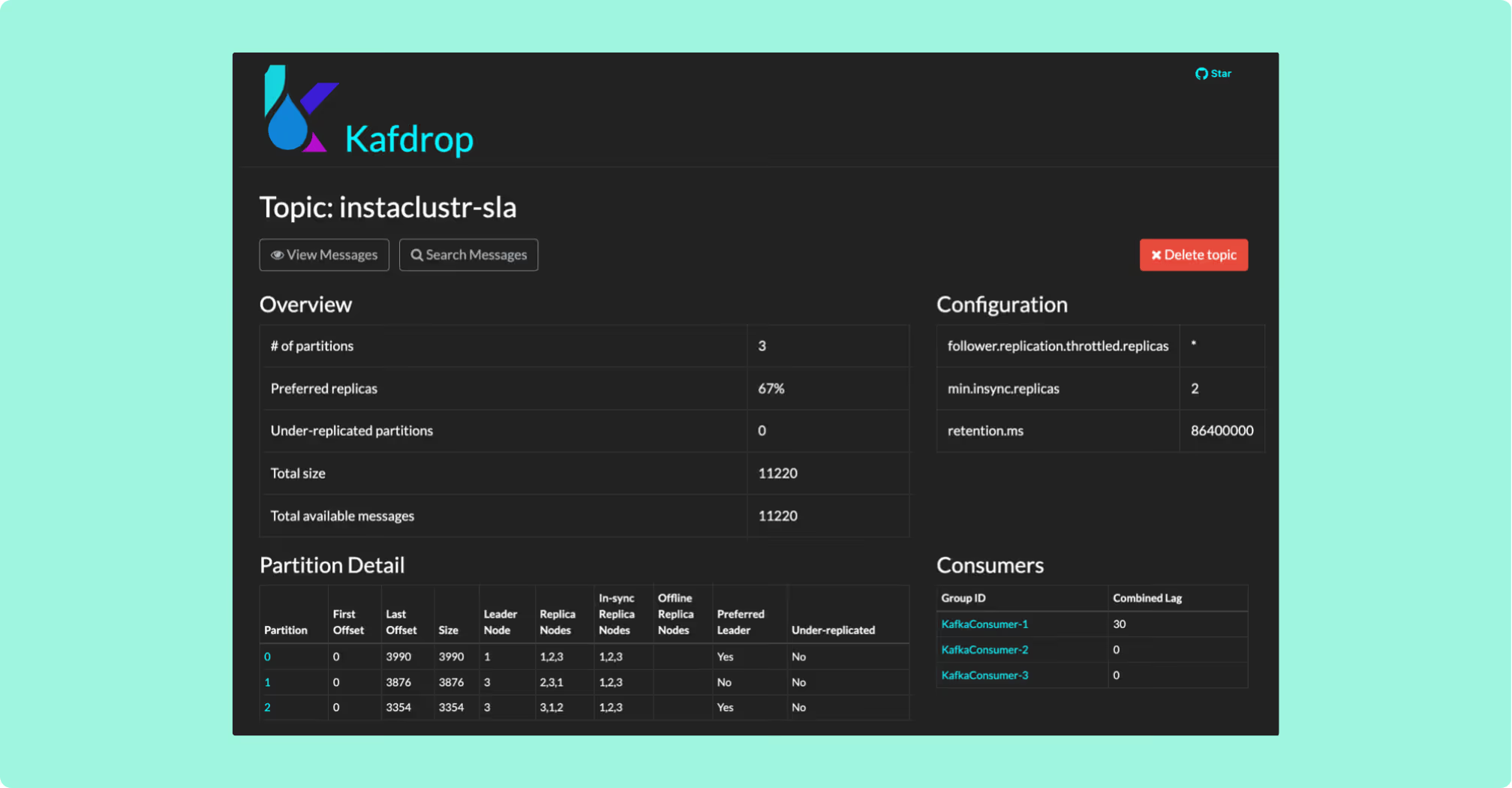
The repository is not archived, carries 6,154 stars and 46 open issues, and last received a push to master on 27 August 2026. The newest tagged release is still 4.2.0, published on 31 July 2025, so the community features merged in August 2026 sit in no published image.
Write operations: exposed, with no read-only mode. The pull request adding that toggle has been open since 30 November 2020.
Scope: the authentication request was opened in January 2026 and closed as not planned six weeks later.
Reach: no multi-cluster management, no message search by key or value, and deserialisation set per topic by hand.
Scale: 5,566 consumer groups pushed load times past 30 minutes, and the UI loaded in under a minute with that enumeration disabled.
Staying patched: 4.3.0 shipped on 31 August 2026 bundling Tomcat 11.0.22, which had carried three critical advisories since 25 August, six days earlier. One of them, CVE-2026-65905, scores 9.8 and is an authentication bypass, and all three are still in the current release. Three releases have shipped in two years. Only 66 of its 118 bundled jars resolve to a Maven coordinate, so those counts are floors rather than totals.
Cost of ownership (modelled): The licence is $0 and the running cost is not. Kafdrop has no authentication of its own, so somebody has to front it with the NGINX basic-auth workaround its README documents and keep that proxy current. On this page’s estimate that is 8 engineer-hours a month to run it and guard it, which at $120 an hour is $11,520 a year. A published Kpow licence is $4,500 per cluster a year for up to 100 users, with role-based access control in the product.
What is the official 2026 pricing of Confluent Control Center and Kafdrop?
Control Center carries no published price. It is bundled with Confluent Platform under an enterprise licence, so the unit is the platform licence rather than a cluster or a seat, and there is nothing to buy for a cluster somebody else runs. Control Center, multi-tenancy support and encryption each carry additional cost. That licence includes quarterly patch updates for the current version only, and the Platinum support tier is not available for this product.
Kafdrop costs nothing to license: Apache 2.0, a single tier, no commercial edition and no supported tier. The whole cost is operator time, and the part that shows up later is that there is nobody to escalate to. The line a platform team actually feels is infrastructure. Control Center wants dedicated nodes: 4 cores, 8 GB of RAM and 200 GB of storage, preferably SSD, for clusters up to 100,000 replicas, and 8 cores with 16 GB above that, with the storage guidance assuming 15 days of metrics retention. Kafdrop is one process on a small heap.
Where does each one run out?
Each tool here is marked out of 10 on five criteria, 50 points in all, and no criterion is weighted above another. Nothing sits behind a multiplier, so a total is the sum of its five marks and a reader can recompute it. The five are cost as teams grow, deployment footprint, support and maintenance, access control and audit, and multi-cluster reach, because those are the questions a Kafka interface is actually measured against after the first month: a second cluster, an access review with a date on it, an upgrade nobody owns, and a bill that moves when the team does. The widest gap between the two marks is on cost as teams grow, where Confluent Control Center marks 2 and Kafdrop marks 10. The marks come from the same matrix used on every comparison on this site, so a tool scores the same here as it does anywhere else, and the reason behind each mark is in the card below, under Why these scores.
The dependency figures in the cards below were read on 24 September 2026 from each project’s published release artefact and matched against the NVD and GitHub advisory databases, so they move whenever a release or an advisory lands. Self-hosting is not the risk on this page. Both run in your own infrastructure. The question is who rebuilds the image when a dependency advisory lands.
Control Center runs out at the edge of the distribution it ships with. It cannot monitor Amazon MSK, Redpanda or Aiven, and MSK’s native IAM authentication is not supported. SAML SSO is not supported on self-managed deployments, where OIDC is the only protocol, so a SAML-only identity provider has no supported path in.
Kafdrop runs out at governance, and the README states the position plainly: it does not implement an authentication mechanism to restrict user access, and documents an NGINX basic-auth workaround instead. There is no RBAC and no SSO, so Kafka’s own authorisation model is the only thing between a user of the UI and the cluster.
KRaft is the thing to settle first, because Apache Kafka 4.0 is the first major release to operate entirely without ZooKeeper. Three KRaft failure reports were all closed as not planned, the last in April 2025, and none has been filed since.
Which should you pick?
Neither of these is a governed answer: Control Center reaches only Confluent Platform brokers and publishes no price of its own, and Kafdrop, which scores 23 against Control Center’s 20, has no authentication, no RBAC and no SSO, with an NGINX workaround in its README instead. A team that needs role-based access and an audit view on any distribution should shortlist Kpow by Factor House, priced per cluster and published.
Pick Control Center if:
- you are on Confluent Platform and staying on it
- Kafka Streams topology visualisation or ksqlDB development is what you want to see
- there are nodes to spare to run the console on
Pick Kafdrop if:
- what you need is a viewer on a cluster you already hold credentials for
- everybody using it holds those credentials anyway
- the deployment should hold no state and be removable by deleting a container
For most readers neither case applies, because neither tool is available to everybody. Control Center is unavailable to anyone not running Confluent Platform, and Kafdrop is unavailable to anyone who cannot hand every user of the console the credentials the container was given. If the console has to reach a cluster somebody else runs, neither of these is the answer. The wider field is scored on the best free Kafka UI tools and on the best Kafka monitoring tools.
Kpow: role-based access, without a distribution or a workaround
Control Center and Kafdrop solve access control by picking an extreme. Control Center’s RBAC only exists inside a Confluent Platform licence, so the governance arrives bundled with a distribution you have to buy first, and it never reaches Amazon MSK, Redpanda or Aiven. Kafdrop has no access control of any kind: no authentication, no RBAC, no SSO, just an NGINX basic-auth workaround its own README points to instead. Kpow by Factor House is licensed per cluster at a published price and runs on top of the cluster you already have as a single stateless container with no external database, authenticating and authorising its own users through role-based access control, with no distribution required and no workaround needed.
Get the access control that’s built in, not bolted on or bundled with a distribution. Start with Kpow on that cluster.
How these tools were scored
Every option is scored from 0 to 10 on each criterion, from the evidence and sources this page cites, and the reason for each score is on its card. Each criterion counts once, for a total out of 50. The options are listed by total.
Sources
- Apache Kafka 4.0.0 release announcement
- Apache Kafka documentation on authorization
- Apache Kafka documentation on consumer groups