Best tools to manage Kafka topics at scale
ComparisonsThe best tools to manage Kafka topics at scale split into two kinds: declarative tools that keep topics in Git, such as the Strimzi Topic Operator, Terraform, topicctl and JulieOps, and consoles that let teams create and change topics under access control, such as Conduktor, AKHQ, Kafbat UI and Kpow. At scale most teams need one of each, because a pipeline gives you the baseline and review, and a console covers incidents and the teams who do not work in the Kafka repository.
Managing topics at scale means handling creation, configuration, ownership, access and deletion across hundreds or thousands of topics and several clusters without the platform team becoming the bottleneck. This page is about choosing the tools. How to size and design the topics themselves, partition counts, replication and retention, is covered in Kafka topic and partition best practices, and the Kafka topics guide is the operational reference.
At a glance
Eight options are scored here on this page's six weighted criteria, 100 points in all. The rubric is weighted: Scoped self-service, approval counts three times, Audit counts three times, and Topics as code, Guardrails on creation, Multi-cluster reach and API and bulk operations count once. The five listed first, of eight, each out of 100: Kpow 78, which takes its best score on Scoped self-service, approval (9 out of 10) and its lowest on Topics as code (1 out of 10); Strimzi Topic Operator 55; Terraform with the Mongey provider 54; topicctl 53; JulieOps 51.
Topic lifecycle and GitOps automation
At a few dozen topics, kafka-topics.sh and a runbook work. At a few hundred, the problems are consistency and history: two topics for the same purpose with different retention, a partition count nobody can explain, and no record of who changed a config. Declarative tools answer that by making the repository the source of truth.
The pattern behind the demand is familiar. An internal thread about one prospect put it plainly: letting a user create and manage topics “required CLI/API hacks”, and they wanted “a safer UI with guardrails”. That is the gap every tool on this page is trying to close, from one side or the other.
The tools compared
Every row uses the same fields in the same order. Cells say why, and the Source column points at each tool’s own documentation.
| Rank | Tool | Topics as code | Creation guardrails | Scoped self-service and approval | Audit | Multi-cluster | API and bulk | Source |
|---|---|---|---|---|---|---|---|---|
| 1 | Kpow | None. Kpow is not a config-as-code tool, though its create form shows the equivalent kafka-topics.sh command. |
Partial. Tenants limit creation to topics matching a name, prefix or suffix. There are no retention or config limits in the current release. | Strong. RBAC with allow, deny or stage per role and resource, tenants that scope what each role sees, and staged mutations for admin approval. | Strong. Every mutation, including bulk actions, is written to the audit log, with webhook delivery. | Strong. Up to 12 clusters per instance. | Strong. REST API, and bulk actions across many topics gated by their own permission. | Kpow topic docs |
| 2 | Terraform (Mongey provider) | Strong. kafka_topic, with import for existing topics. |
Terraform validation and policy tooling you add. | Git review. | Git and plan history. | One provider block per cluster. | Terraform workflow. Also manages ACLs, quotas and SCRAM users. | terraform-provider-kafka |
| 3 | Strimzi Topic Operator | Strong. One KafkaTopic resource per topic, and changes made outside the resource are reverted. |
Kubernetes admission controls or CI checks you add. | Kubernetes RBAC and namespaces. | Git and Kubernetes history. | One operator per Kafka cluster. | Kubernetes API. Topics without a KafkaTopic resource are left alone. |
Strimzi Topic Operator |
| 4 | topicctl | Strong. YAML per topic, applied with apply, plus replica placement strategies. |
Partial. Declared settings per topic, and it refuses to rebalance topics whose partition count or retention differs from the YAML. | Git review, with a confirmation required for every mutation. | Git history. | A cluster config per cluster, checked against the cluster ID before apply. | CLI and a read-only REPL. Topics are never deleted by apply. | topicctl |
| 5 | JulieOps | Strong for topics, ACLs, schemas and connectors. | Partial. Reusable config plans give topics named service levels. | Git review. | Git history. | One topology per cluster. | CLI in CI. The maintainer describes the project as in hibernation, last push June 2024. | JulieOps |
| 6 | AKHQ | None. | None beyond RBAC scope. | Partial. RBAC with regex patterns on resource names. | Partial. Opt-in audit events to a Kafka topic for topic create, config change, partition increase and delete. | Yes, several clusters in one instance. | REST API. | AKHQ audit docs |
| 7 | Kafbat UI | None. | None beyond RBAC scope. | Partial. RBAC with regex values on topic names. | Partial. Opt-in audit log to a topic or the console. | Yes, several clusters in one instance. | REST API. | Kafbat UI RBAC docs |
| 8 | kafka-topics.sh and kafka-configs.sh | Only if you script it. | None beyond cluster defaults. | None. Kafka ACLs decide who can create topics. | None in the tool. | One cluster per invocation. | Scriptable, one topic per call. | Apache Kafka operations |
| 9 | Conduktor Self-service | Strong. Every change goes into Git. | Strong. Policies such as maximum partitions and naming conventions. | Strong. Applications own resources, and access requests go to the owning team. | Git history. | Part of the Conduktor platform. | API and GitOps resources. | Conduktor’s documentation, “Kafka self-service: topic requests and governed access” |
Scoring notes. On creation guardrails, Conduktor’s policies are ahead of Kpow, which today limits creation by topic name through tenants and does not enforce retention or config limits. On topics as code, the Strimzi Topic Operator and Terraform are ahead of every console, Kpow included. Kpow is strongest where many teams share clusters: scoped visibility, staged approval, audit and bulk operations across up to 12 clusters.
Kpow live demo
Try governed topic management
Use the Kpow demo to browse topics, their config sources and the topic create form that generates the matching kafka-topics.sh command.
For platform teams sharing clusters across many teams.
Try the Kpow demoTopics as code
 Rank 2
 Strimzi Topic Operator
55 out of 100 Total
- Unit
- One KafkaTopic resource per topic
- Drift
- Changes made outside it are reverted
- Reach
- One operator per Kafka cluster
- Topics as code
- 10 out of 10
- Guardrails on creation
- 5 out of 10
- Scoped self-service, approval ×3 weight, this criterion counts 3 times toward the total
- 5 out of 10
- Audit ×3 weight, this criterion counts 3 times toward the total
- 5 out of 10
- Multi-cluster reach
- 4 out of 10
- API and bulk operations
- 6 out of 10
Why these scores for Strimzi Topic Operator
- Topics as code 10 out of 10
- The comparison table on this page rates it “Strong. One
KafkaTopicresource per topic, and changes made outside the resource are reverted”, and the page’s own prose calls that “real drift correction, not only drift detection”. The scoring notes put Strimzi ahead of every console, and it is the only option on the page that reverts drift. - Guardrails on creation 5 out of 10
- Limits come from “Kubernetes admission controls or CI checks you add”, so they are possible but are work the reader does.
- Scoped self-service, approval 5 out of 10
- Scoping comes from “Kubernetes RBAC and namespaces”, approval is whatever the repository’s review is, and the page names no staged step.
- Audit 5 out of 10
- The audit trail is “Git and Kubernetes history”, and the FAQ says Git history covers only changes that went through the pipeline.
- Multi-cluster reach 4 out of 10
- It runs “One operator per Kafka cluster”, and the page’s own prose adds “Strimzi-managed Kafka on Kubernetes only”, the narrowest reach of the declarative four.
- API and bulk operations 6 out of 10
- Changes go through the “Kubernetes API. Topics without a
KafkaTopicresource are left alone.” That is an API with one resource per topic, and no bulk action is described.
What it is. A Kubernetes operator that manages one Kafka topic per KafkaTopic resource.
Where it wins. The Strimzi documentation states that when a KafkaTopic exists, “any configuration changes made outside the resource are reverted”, which gives you real drift correction, not only drift detection. It also leaves topics without a resource alone, so you can adopt it gradually.
Where it falls short. Strimzi-managed Kafka on Kubernetes only, and Kafka topic names that are not valid Kubernetes names need the separate spec.topicName field.
Staying patched. Strimzi is community-maintained under the CNCF and it answers the patching question better than most vendors do. Thirty-eight releases in two years, six published CVEs, each with a coordinated-disclosure advisory, and on the last three batches the fixed release shipped the same day the advisory was published: 0.49.1 in December 2025, 0.50.1 in February 2026 and 1.0.1 in June 2026. Open source is not the risk here. The absence of a contract is, and Strimzi shows how little that has cost so far.
Terraform with the Mongey provider
54 out of 100 Total
- Resources
- Topic, ACL, quota, SCRAM user
- Existing topics
- Imported
- Reach
- One provider block per cluster
- Topics as code
- 9 out of 10
- Guardrails on creation
- 5 out of 10
- Scoped self-service, approval ×3 weight, this criterion counts 3 times toward the total
- 4 out of 10
- Audit ×3 weight, this criterion counts 3 times toward the total
- 5 out of 10
- Multi-cluster reach
- 6 out of 10
- API and bulk operations
- 7 out of 10
Why these scores for Terraform with the Mongey provider
- Topics as code 9 out of 10
- This page’s table rates it “Strong.
kafka_topic, with import for existing topics.” The scoring notes name it with Strimzi as ahead of every console, and it sits below Strimzi because it detects drift in a plan but does not revert it. - Guardrails on creation 5 out of 10
- Guardrails are “Terraform validation and policy tooling you add”, and the page’s own prose says “Guardrails are whatever policy tooling you add around Terraform”.
- Scoped self-service, approval 4 out of 10
- Approval is “Git review.” There is no scoping, ownership or approval mechanism of its own, so it sits below Strimzi’s namespaces and RBAC.
- Audit 5 out of 10
- The record is “Git and plan history”, and the FAQ says Git history covers only changes that went through the pipeline.
- Multi-cluster reach 6 out of 10
- It takes “One provider block per cluster”, and the FAQ names Terraform for handling multiple clusters through one configuration per cluster.
- API and bulk operations 7 out of 10
- Bulk work is a “Terraform workflow. Also manages ACLs, quotas and SCRAM users.” One apply changes many topics, and a plan shows every change first.
What it is. The open-source Terraform provider for Kafka, with kafka_topic, kafka_acl, kafka_quota and kafka_user_scram_credential resources.
Where it wins. Topics sit next to the rest of your infrastructure code, existing topics can be imported, and a plan shows every change before it applies.
Where it falls short. Guardrails are whatever policy tooling you add around Terraform, and a topic created outside Terraform stays invisible to it until someone imports it.
Staying patched. The Mongey Terraform Kafka provider is MIT. The repository was last pushed in August 2026 but it has not cut a release in 367 days, since v0.13.1 in September 2025, so anything fixed on its main branch is not in the provider you download.
topicctl
53 out of 100 Total
- Unit
- One YAML file per topic
- Deletes on apply
- Never
- Before apply
- Cluster ID is checked
- Topics as code
- 8 out of 10
- Guardrails on creation
- 5 out of 10
- Scoped self-service, approval ×3 weight, this criterion counts 3 times toward the total
- 4 out of 10
- Audit ×3 weight, this criterion counts 3 times toward the total
- 5 out of 10
- Multi-cluster reach
- 6 out of 10
- API and bulk operations
- 7 out of 10
Why these scores for topicctl
- Topics as code 8 out of 10
- It scores “Strong. YAML per topic, applied with
apply, plus replica placement strategies.” That is a clean pass, held below Terraform because it covers topics and ACLs rather than the surrounding infrastructure. - Guardrails on creation 5 out of 10
- Guardrails are “Partial. Declared settings per topic, and it refuses to rebalance topics whose partition count or retention differs from the YAML.” It blocks a rebalance on drift, and it does not cap what a topic may declare.
- Scoped self-service, approval 4 out of 10
- It offers “Git review, with a confirmation required for every mutation”, and the page’s own prose says “ownership, approval and self-service live in your Git process”.
- Audit 5 out of 10
- Auditing rests on “Git history”, which the FAQ says covers only changes that went through the pipeline.
- Multi-cluster reach 6 out of 10
- It uses “A cluster config per cluster, checked against the cluster ID before apply”, and the FAQ names topicctl for multiple clusters.
- API and bulk operations 7 out of 10
- It gives a “CLI and a read-only REPL. Topics are never deleted by apply.” One apply covers many topics, and the page’s own prose lists interruptible, idempotent runs and per-cluster locking, with no HTTP API for a developer portal.
What it is. Segment’s open-source tool for declarative topic management, inspired by kubectl.
Where it wins. Its safety properties are written for exactly this job: user confirmation for every mutation, topics never deleted by apply, partitions added but never removed, interruptible and idempotent runs, per-cluster locking and a cluster ID check before apply.
Where it falls short. It manages topics and ACLs from YAML, but ownership, approval and self-service live in your Git process.
Staying patched. topicctl is MIT and actively released, twelve releases in two years and v2.0.2 in March 2026, with no CVE filed against its own code. Nobody is contracted to ship a patch for it, so the currency of what it bundles is yours to check.
 Rank 5
 JulieOps
51 out of 100 Total
- Covers
- Topics, ACLs, schemas, connectors
- Guardrail
- Reusable config plans
- Status
- Hibernation, last push June 2024
- Topics as code
- 8 out of 10
- Guardrails on creation
- 6 out of 10
- Scoped self-service, approval ×3 weight, this criterion counts 3 times toward the total
- 4 out of 10
- Audit ×3 weight, this criterion counts 3 times toward the total
- 5 out of 10
- Multi-cluster reach
- 5 out of 10
- API and bulk operations
- 5 out of 10
Why these scores for JulieOps
- Topics as code 8 out of 10
- It is “Strong for topics, ACLs, schemas and connectors.” That is the widest declarative scope on the page, held at 8 because the maintainer describes the project as in hibernation.
- Guardrails on creation 6 out of 10
- Its guardrails are “Partial. Reusable config plans give topics named service levels”, and the page’s own prose calls a retention and message size profile applied to many topics “a practical guardrail”. That puts it above the tools whose limits are checks you write, and below Conduktor’s policies.
- Scoped self-service, approval 4 out of 10
- Self-service is “Git review.” There is no scoping, ownership or approval step of its own.
- Audit 5 out of 10
- Records live in “Git history”, which the FAQ says covers only changes that went through the pipeline.
- Multi-cluster reach 5 out of 10
- It takes “One topology per cluster.” That is the same shape as the other declarative tools, with no cluster ID check or import path named.
- API and bulk operations 5 out of 10
- It runs as a “CLI in CI. The maintainer describes the project as in hibernation, last push June 2024.” A topology applies to many topics at once, but there is no API and the project is dormant.
What it is. A GitOps tool, formerly Kafka Topology Builder, for topics, access control, schemas and connectors, with reusable configuration plans.
Where it wins. Plans let you define named service levels, such as a retention and message size profile, and apply them to many topics, which is a practical guardrail.
Where it falls short. Its maintainer’s note says the project is “mostly on a long winter hibernation”, so check its activity before building on it.
Staying patched. JulieOps is MIT, last released v4.4.1 in October 2022 and last pushed in June 2024, with no CVE filed against its own code. There is no release coming to carry a dependency fix.
User interfaces and self-service portals
 Rank 1
 Kpow
78 out of 100 Total
Try Kpow in the live demo No signup needed.
- Scoping
- Tenants by name, prefix or suffix
- Approval
- Staged mutations
- Clusters per instance
- Up to 12
- Topics as code
- 1 out of 10
- Guardrails on creation
- 5 out of 10
- Scoped self-service, approval ×3 weight, this criterion counts 3 times toward the total
- 9 out of 10
- Audit ×3 weight, this criterion counts 3 times toward the total
- 9 out of 10
- Multi-cluster reach
- 9 out of 10
- API and bulk operations
- 9 out of 10
Why these scores for Kpow
- Topics as code 1 out of 10
- It is “None. Kpow is not a config-as-code tool, though its create form shows the equivalent
kafka-topics.shcommand.” The generated command is all that remains, and the scoring notes put Strimzi and Terraform ahead. - Guardrails on creation 5 out of 10
- Creation limits are “Partial. Tenants limit creation to topics matching a name, prefix or suffix. There are no retention or config limits in the current release”, and the scoring notes say “Conduktor’s policies are ahead of Kpow”.
- Scoped self-service, approval 9 out of 10
- It is “Strong. RBAC with allow, deny or stage per role and resource, tenants that scope what each role sees, and staged mutations for admin approval.” The scoring notes say Kpow is strongest on scoped visibility and staged approval, the two halves this criterion asks for.
- Audit 9 out of 10
- Auditing is “Strong. Every mutation, including bulk actions, is written to the audit log, with webhook delivery.” That is the only Strong audit cell on the page, and every other option relies on Git or an opt-in topic.
- Multi-cluster reach 9 out of 10
- Reach is “Strong. Up to 12 clusters per instance.” That is the only cell that names a number, and the highest on the page.
- API and bulk operations 9 out of 10
- It is “Strong. REST API, and bulk actions across many topics gated by their own permission”, and the page’s own prose gives the concrete case, “deleting 300 topics in a request”. That is the only bulk action with its own permission.
What it is. Factor House’s Kafka management and monitoring product.
Where it wins. Governed operations across teams and clusters. Tenants restrict each role to topics by name, prefix or suffix, and a user can only create topics valid for their tenant. RBAC policies can stage an action instead of allowing it, so a topic request waits for an administrator. Bulk actions run one mutation across many resources, such as deleting 300 topics in a request, under their own permission. How to keep deletions like that safe is covered in the comparison of tools for controlling destructive Kafka operations. Every mutation lands in the audit log. The topic create form suggests the five most common values used on your cluster for each config, can copy another topic’s config, and shows the equivalent kafka-topics.sh command if you would rather run it through your pipeline.
Where it falls short. It does not enforce retention or config limits on creation in the current release, and it is not a config-as-code tool. Pair it with a declarative baseline if you need one.
Staying patched. Kpow’s release notes name the CVEs each release remediates, and the 96.4 image built on 5 August 2026 bundles 311 dependencies of which one carries a high or critical advisory, none of them published before that release. That is not a claim to patch faster than a community project: Kpow’s own dependency remediation has run from 14 to 128 days, and the current image still ships CVE-2026-75595 in netty, a 9.1 critical public since 19 August 2026, unpatched. What a licence buys here is not a different deployment model, because Kpow is self-hosted too. It is a company contracted to ship the fix. Every dependency figure on this page was read on 24 September 2026 from the published artefacts and from nvd.nist.gov.
Compare Kpow vs AKHQKpow vs Kafbat UI
 Rank 6
 AKHQ
46 out of 100 Total
- Scoping
- RBAC regex on resource names
- Audit
- Opt-in, to a Kafka topic
- Clusters
- Several in one instance
- Topics as code
- 0 out of 10
- Guardrails on creation
- 2 out of 10
- Scoped self-service, approval ×3 weight, this criterion counts 3 times toward the total
- 5 out of 10
- Audit ×3 weight, this criterion counts 3 times toward the total
- 5 out of 10
- Multi-cluster reach
- 8 out of 10
- API and bulk operations
- 6 out of 10
Why these scores for AKHQ
- Topics as code 0 out of 10
- It scores “None.” Nothing in AKHQ keeps a desired state.
- Guardrails on creation 2 out of 10
- It has “None beyond RBAC scope”, and the page’s own prose says “No creation guardrails or approval step”. Only the name pattern in an RBAC group remains, so a small indirect form of a limit.
- Scoped self-service, approval 5 out of 10
- It is “Partial. RBAC with regex patterns on resource names.” Access is scoped, but the page’s own prose says there is no approval step, so half the criterion is missing.
- Audit 5 out of 10
- Auditing is “Partial. Opt-in audit events to a Kafka topic for topic create, config change, partition increase and delete”, and the page’s own prose says “auditing is off until configured”.
- Multi-cluster reach 8 out of 10
- It answers “Yes, several clusters in one instance”, the FAQ repeats it, and that is a clean pass with no published cap.
- API and bulk operations 6 out of 10
- It has a “REST API.” The API is there for a portal or pipeline, and the page describes no bulk action across many topics.
What it is. A free, self-hosted Kafka UI. Its RBAC groups can restrict roles to resources matching regular expressions, and its audit configuration can emit events for topic creation, configuration changes, partition increases and deletion to a Kafka topic.
Where it wins. Free, widely used, and scoped access by name pattern.
Where it falls short. No creation guardrails or approval step, and auditing is off until configured.
Staying patched. AKHQ has no CVE filed against its own code, and that is the wrong number to plan against. Release 0.28.0, cut on 6 August 2026, bundles 270 libraries and 18 of them carry a high or critical advisory. Sixteen were already public, with fixed versions already on Maven Central, on the day it shipped, and five are netty advisories Kpow had remediated three weeks earlier in 96.2: CVE-2026-44249, CVE-2026-45416, CVE-2026-45674, CVE-2026-47691 and CVE-2026-50010. The oldest has been open 108 days. That is exposure and remediation latency rather than a working attack, and every figure resolves against the published jar and nvd.nist.gov. Four releases in two years, and no security policy at any path GitHub reads.
 Rank 7
 Kafbat UI
46 out of 100 Total
- Scoping
- RBAC regex on topic names
- Audit
- Opt-in, to a topic or the console
- Clusters
- Several in one instance
- Topics as code
- 0 out of 10
- Guardrails on creation
- 2 out of 10
- Scoped self-service, approval ×3 weight, this criterion counts 3 times toward the total
- 5 out of 10
- Audit ×3 weight, this criterion counts 3 times toward the total
- 5 out of 10
- Multi-cluster reach
- 8 out of 10
- API and bulk operations
- 6 out of 10
Why these scores for Kafbat UI
- Topics as code 0 out of 10
- This page’s table records “None.” Nothing in Kafbat UI keeps a desired state.
- Guardrails on creation 2 out of 10
- Guardrails are “None beyond RBAC scope”, and the page’s own prose says “No creation guardrails or approval step”. Only the regex on topic names remains.
- Scoped self-service, approval 5 out of 10
- It offers “Partial. RBAC with regex values on topic names”, and the page’s own prose says “Access is scoped but not staged”, so the approval half is missing.
- Audit 5 out of 10
- It has a “Partial. Opt-in audit log to a topic or the console.” That is the same shape as AKHQ, off until configured.
- Multi-cluster reach 8 out of 10
- This page’s table gives “Yes, several clusters in one instance”, and the FAQ repeats it.
- API and bulk operations 6 out of 10
- It exposes a “REST API.” No bulk action across many topics is described.
What it is. The actively maintained fork of the former Provectus Kafka UI, with topic creation and configuration, RBAC with regex values on topic names, and an opt-in audit log.
Where it wins. Free, self-hosted and quick to deploy.
Where it falls short. No creation guardrails or approval step. Access is scoped but not staged.
Staying patched. Kafbat UI released v1.5.0 in April 2026 and has not shipped since. In the 157 days since, at least 20 high or critical advisories have been published against libraries that release bundles, including the same netty critical CVE-2026-75595 that the current Kpow image carries. Only 150 of its 266 bundled jars resolved to a Maven coordinate, so that count is a floor and the state of the release itself is unmeasured. Kafbat does publish a security policy, which AKHQ and Kafdrop do not, and the one CVE filed against its own code, CVE-2025-49127, was already fixed in the release that preceded the advisory. Six releases in two years.
 Rank 8
 Conduktor Self-service
conduktor.io
69 out of 100 Total
- Policies
- Maximum partitions, naming conventions
- Ownership
- Applications own their topics and ACLs
- Change record
- Git
- Topics as code
- 8 out of 10
- Guardrails on creation
- 10 out of 10
- Scoped self-service, approval ×3 weight, this criterion counts 3 times toward the total
- 8 out of 10
- Audit ×3 weight, this criterion counts 3 times toward the total
- 5 out of 10
- Multi-cluster reach
- 5 out of 10
- API and bulk operations
- 7 out of 10
Why these scores for Conduktor Self-service
- Topics as code 8 out of 10
- It is “Strong. Every change goes into Git.” This is a console that keeps a Git record, held below Strimzi and Terraform because the scoring notes put both ahead of every console.
- Guardrails on creation 10 out of 10
- It is “Strong. Policies such as maximum partitions and naming conventions”, the page’s own prose calls it “The most complete creation guardrails and ownership model in this list”, and the scoring notes say “Conduktor’s policies are ahead of Kpow”. It is the only option on the page that caps what a topic may declare.
- Scoped self-service, approval 8 out of 10
- This page’s table calls it “Strong. Applications own resources, and access requests go to the owning team.” It sits below Kpow because the scoring notes say Kpow is strongest on scoped visibility and staged approval, which is what this criterion asks for, and Conduktor’s superlative in the prose is for its ownership model.
- Audit 5 out of 10
- Auditing is “Git history.” There is no audit log in the tool, so it gets the same score as the declarative tools that rely on Git.
- Multi-cluster reach 5 out of 10
- It is “Part of the Conduktor platform”, which states no cluster count, so a neutral 5.
- API and bulk operations 7 out of 10
- It exposes “API and GitOps resources.” That is an API plus a GitOps path that covers many topics in one change, with no bulk action on the console side described.
What it is. Part of Conduktor’s commercial platform. Its documentation describes applications that own their topics and ACLs, policies that constrain requests such as maximum partitions and naming conventions, and access requests routed to the owning team, with every change stored in Git.
Where it wins. The most complete creation guardrails and ownership model in this list.
Where it falls short. It is a commercial platform decision, not a standalone topic tool, and the ownership model has to be set up before teams see the benefit.
Rebalancing as topics grow
Topics at scale bring partition placement problems with them: new brokers that receive none of the existing partitions, and brokers that end up leading more than their share. The Kafka CLI moves partitions, and Cruise Control plans and executes rebalances against goals such as rack awareness and disk balance. The comparison of partition reassignment tools scores the options on planning, throttling and cancellation. Kpow reassigns individual partitions and runs leader elections from a topic’s page. Kafka cluster management covers where reassignment fits in day-to-day operations.
Schema registry and evolution
Topic management at scale includes the schemas on those topics. Confluent Schema Registry and Apicurio Registry enforce Avro, Protobuf or JSON Schema compatibility so a producer cannot publish data that breaks consumers. JulieOps can declare schemas alongside topics, and Kpow, AKHQ and Kafbat UI all connect to a schema registry to browse and manage subjects. The Kpow schema documentation covers what it supports, and the comparison of schema registry management tools covers the wider choice.
How Factor House approaches topic management at scale
Factor House built Kpow for clusters shared by many teams, where the question is less “how do I create a topic” and more “who is allowed to create which topics, who approved it, and what changed”. Tenants give each team a view of only its own topics, staged mutations put an approval step in front of creation or deletion, bulk actions handle cleanup across hundreds of topics, and the audit log records all of it. The Kpow multi-tenancy documentation shows how tenants are defined in the RBAC configuration. To test the topic side in practice, open the Kpow demo: filter the topic list, open a topic’s configuration with each value’s source, and walk through the create form with its common values and generated kafka-topics.sh command.
What Factor House has not built is retention and config guardrails on creation. For a hard limit on retention or partition count today, enforce it in a pipeline with Strimzi, Terraform or topicctl, and use Kpow for visibility, scoped access and audit across the clusters. For the design decisions the guardrails should encode, Kafka topic vs partition explains why partition count is the one you cannot easily undo.
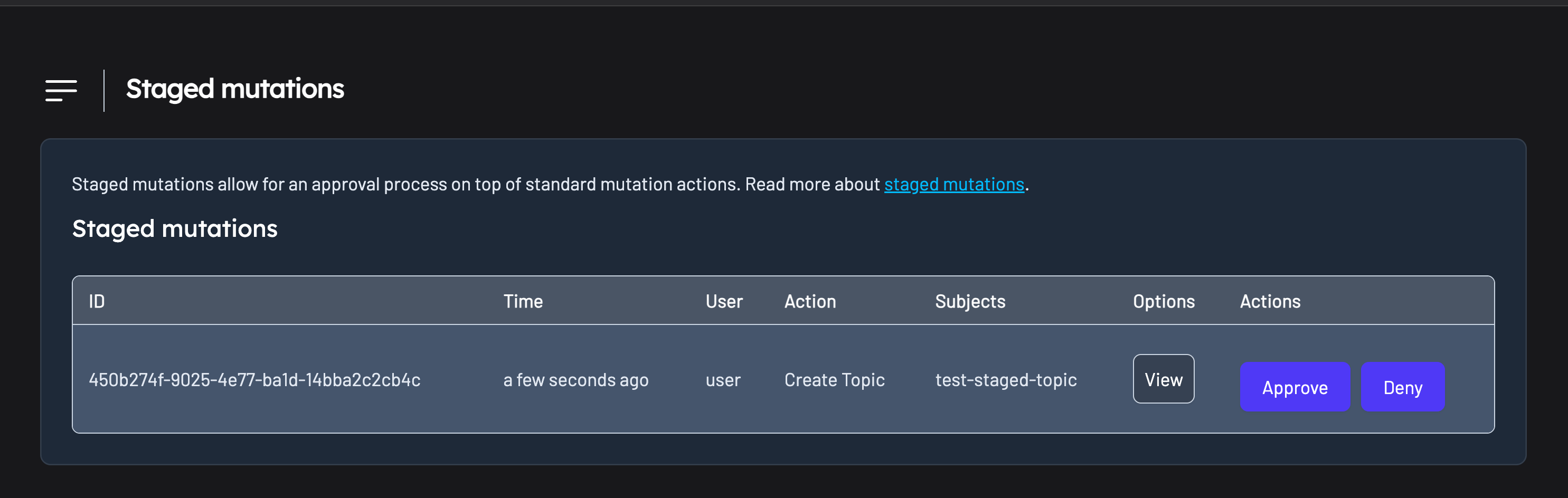
Kpow Staged mutations: a Create Topic request for test-staged-topic is held as pending, with Approve and Deny actions beside it.
How to choose
One platform team, topics in Git. Strimzi’s Topic Operator on Kubernetes, otherwise Terraform or topicctl.
Many teams creating topics, with hard policy limits. A self-service platform with policies, such as Conduktor, or a pipeline with policy checks in CI.
Many teams on shared clusters, with a need for scoped access, approval and audit. A console with tenancy, staged approval and an audit log, such as Kpow, alongside whatever declarative baseline you keep.
Small team, low budget. AKHQ or Kafbat UI with auditing turned on. The broader Kafka management tools comparison covers these consoles beyond topic management.
FAQ
What is the best way to manage Kafka topics as code?
On Kubernetes with Strimzi, the Topic Operator’s KafkaTopic resource, which also reverts changes made outside it. Elsewhere, the Mongey Terraform provider or topicctl. All three keep the desired state in Git and apply it through a reviewed change.
How do I stop teams creating badly configured Kafka topics?
Enforce limits where topics are created. In a pipeline, that means CI checks on the YAML or Terraform. In a console, it means policies (Conduktor), name-scoped permissions (AKHQ, Kafbat UI, Kpow tenants) and an approval step (Kpow staged mutations). Set sensible cluster defaults as the last line of defence.
Can I manage Kafka topics across multiple clusters from one tool?
Yes. Kpow manages up to 12 clusters per instance, and AKHQ and Kafbat UI both support several clusters. Declarative tools such as Terraform and topicctl handle multiple clusters through one configuration per cluster.
Is there a Kafka topic management tool with an audit log?
Kpow records every mutation in its audit log. AKHQ and Kafbat UI can write audit events to a Kafka topic once auditing is enabled. Declarative tools rely on Git history, which covers only changes that went through the pipeline.
How these tools were scored
These six criteria decide whether a tool holds up past a few hundred topics.
1. Topics as code. Can the desired state of every topic live in a repository, be reviewed as a pull request and be applied by CI? This is how consistency survives team turnover.
2. Guardrails on creation. The costly topic mistakes are defaults that look harmless on day one. In the Kafka operational issues talk Chad Harris called out two. Retention set too high on a high-throughput topic “is a slow-burn problem”, because disk fills over weeks until it is suddenly urgent, and “Running out of disk is about the worst state Kafka can be in”. And a generous max.message.bytes “is a trap that tends to spring later”, when the topic becomes popular. A good tool enforces naming, partition, retention and size limits at creation.
3. Scoped self-service with approval. Teams should create and change their own topics without being able to touch another team’s. The comparison of Kafka RBAC tools covers how each tool scopes access. Tom Crowley, Factor House’s founding engineer, describes Kpow’s answer to the approval part in one line: “We have optional approval via staged mutations”. The alternative, a ticket to the platform team for every topic, is the bottleneck the search is usually about.
4. Audit. Who created, changed or deleted a topic, and when. Without it, a missing topic or a changed retention is a forensics exercise.
5. Multi-cluster reach. Dev, staging and several production clusters, ideally from one place. On cluster count itself his view is that fewer, larger shared clusters beat one per team: in the talk’s Q&A he said splitting clusters along governance domains is inefficient because those domains keep changing, and better governance and audit controls are the better answer. That makes the topic tooling on a shared cluster matter more, not less.
6. API and bulk operations. At scale, clicking through a UI one topic at a time does not work. The tool needs an API that fits into an internal developer portal or pipeline, and a safe way to act on many topics at once.
Every option is scored from 0 to 10 on each criterion, from the evidence and sources this page cites, and the reason for each score is on its card. The criteria are weighted: Topics as code counts once, Guardrails on creation counts once, Scoped self-service, approval counts three times, Audit counts three times, Multi-cluster reach counts once and API and bulk operations counts once, for a total out of 100. Audit and Scoped self-service and approval count three times here, because topic management at scale is a delegation problem: the point is to let application teams create and change their own topics without giving anyone the ability to delete somebody else's without trace. Topics as code, guardrails on creation, multi-cluster reach and API and bulk operations count once. This page is published by Factor House, which makes Kpow. Every option is scored on the same rubric and the same sources: Kpow's per-criterion scores are set the same way as every other option's and are not adjusted, and the weights apply to every option alike. Kpow ranks first on its total of 78 out of 100. The other options follow by total. Conduktor Self-service is listed last whatever its total; on its total of 69 it would place second.